


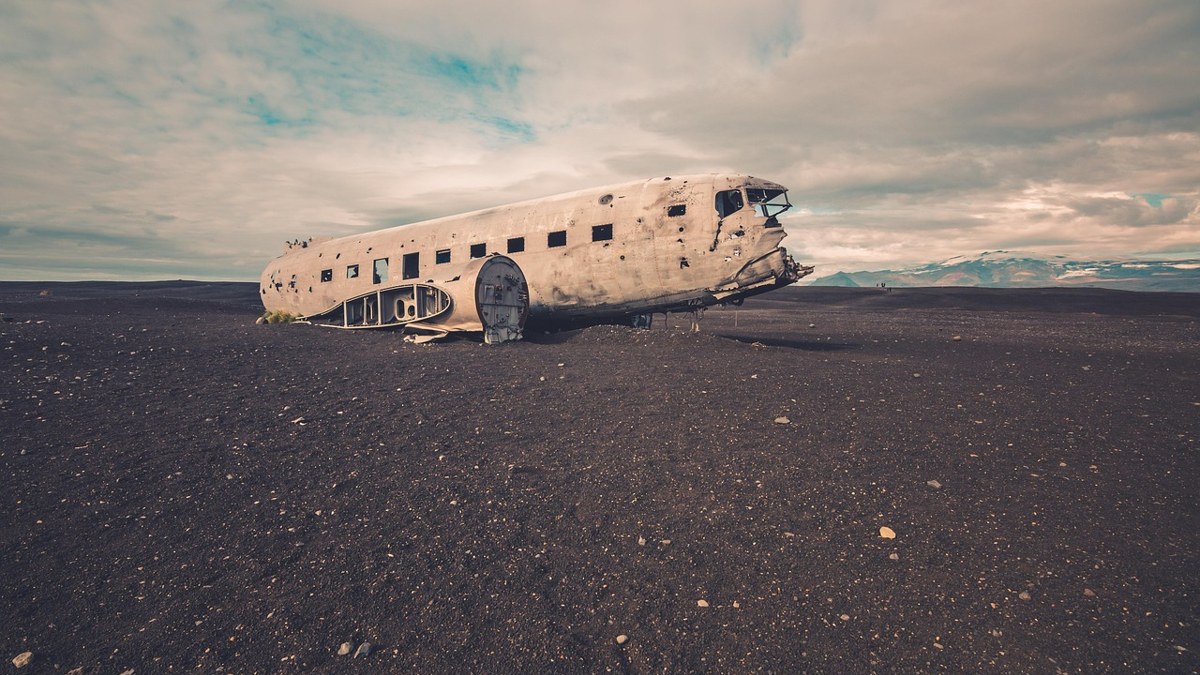
After every major crash the same sentence appears in the news: “the search for the black boxes continues.” Then, weeks or months later, investigators announce what the recorders showed, and the story of the accident changes completely. Yet almost everything the public believes about these devices is wrong, starting with the name. They are not black. There are two of them, not one. They are not indestructible, and in one famous case a recorder from a 30-year-old airliner outlived the aircraft by decades sitting in a lagoon. Here is what a black box actually is, what it records, why it survives what the aeroplane does not, and why they are still so hard to find.
They are orange, and there are two of them
Flight recorders are painted bright orange, usually with reflective tape, for the obvious reason that somebody has to spot them in wreckage, water or jungle. The nickname “black box” is older than the modern recorder and probably comes from wartime engineering slang for any sealed instrument nobody outside the lab was meant to open.
Every airliner carries two separate units:
- The Flight Data Recorder (FDR). This logs what the aircraft was doing. Early 1960s recorders scratched five parameters onto metal foil. A modern FDR captures anywhere from 88 mandated parameters to well over a thousand: altitude, airspeed, heading, pitch, roll, engine settings, every control-surface position, flap and gear selection, autopilot mode, warnings, and the position of individual switches, several times a second, for the last 25 hours of operation.
- The Cockpit Voice Recorder (CVR). This logs what the crew heard and said: each pilot’s microphone, the radio traffic, and an area microphone in the ceiling that picks up the ambient sound of the flight deck, including switch clicks, alarms, engine noise and the rush of air. Until recently CVRs kept the last two hours; in 2026 new US aircraft are required to carry 25-hour CVRs, and Europe has been moving the same way, after a string of investigations in which the crucial conversation had already been overwritten by the time the aircraft landed.
On many modern aircraft the two are combined into a single unit, and larger jets often carry two of those, one in the tail and one forward, so that a fire or impact that destroys one may spare the other.
Why they are in the tail
Recorders are installed as far aft as practical, usually in the rear pressure bulkhead area. It is not tradition. The tail is statistically the last part of the aircraft to arrive at the crash site, it takes the lowest impact loads in a nose-first accident, and it is furthest from the fuel in the wings and centre tank. The same reasoning that makes the rear of the cabin marginally safer for passengers puts the recorders there too.
What “crash-proof” actually means
The survivable part is not the whole box. Inside the orange casing is a smaller armoured cylinder, the Crash Survivable Memory Unit, which holds solid-state memory chips wrapped in layers of aluminium, high-temperature insulation and stainless steel or titanium. That core has to pass a deliberately brutal certification programme, and the numbers are worth knowing:
- Impact: 3,400 g for 6.5 milliseconds, the equivalent of being fired into a steel target at around 750 km/h.
- Static crush: 5,000 pounds of force for five minutes on each axis.
- Penetration: a 500 lb weight with a hardened steel spike dropped from 3 metres onto the most vulnerable point.
- Fire: 1,100°C flames on all sides for one hour, followed by a 260°C low-temperature soak for ten hours, because wreckage fires smoulder long after the flames die.
- Water: submersion under 6,000 metres of seawater pressure for 24 hours, and 30 days in salt water at shallower depth.
Solid-state memory helps enormously: there are no moving parts, no tape to melt or snap. Recorders have been recovered intact from accidents no human could survive, and investigators have read data off units that arrived at the laboratory as scorched, crushed lumps of metal.
The pinger, and why it still is not enough
Bolted to each recorder is an Underwater Locator Beacon, a small cylinder that switches itself on the moment it gets wet and emits an ultrasonic ping, once a second, at 37.5 kHz. After Air France 447 went into the Atlantic in 2009 and took two years to find, the rules changed: beacon battery life was extended from 30 to 90 days, and long-range beacons transmitting at 8.8 kHz, audible from far greater distances, are now required on aircraft flying long overwater routes.
Even so, the ocean is enormous. AF447’s recorders were eventually found at 3,900 metres after four search campaigns. Malaysia Airlines MH370’s have never been found at all, which is the single biggest reason regulators are now pushing for aircraft that stream their position, and in some proposals their flight data, live to the ground so that the recorders become a confirmation rather than the only source of truth.
What they actually solve
The reason investigators care so much is that the two recorders together answer different halves of the same question. The FDR says what the aircraft did. The CVR says what the crew believed was happening. Accidents are very often the gap between those two things: an aeroplane doing exactly what it was told while the people on board misunderstood the situation, or a crew fighting a failure the data shows had already made the outcome inevitable.
The CVR is also the most sensitive recording in aviation. Pilot unions fought hard, and largely successfully, to restrict its use: transcripts are published in accident reports but the audio itself is not released, it cannot normally be used for disciplinary action, and in most countries it is a criminal offence to publish the recording. That protection is what makes pilots willing to speak freely on the flight deck in the first place, which is exactly what makes the recording useful.
The things people get wrong
- “They should make the whole plane out of that material.” A recorder core is a small, dense lump with no need for windows, doors, seats or lift. Scaling it up would produce something far too heavy to fly.
- “The black box records video.” It does not. Cockpit image recorders have been proposed for decades and resisted every time, largely on privacy grounds.
- “They always find them.” Usually, but not always: MH370 remains the most famous exception, and in some remote or deep-water accidents recovery has taken years.
- “The data is read out in a day.” A recovered unit goes to a laboratory such as the NTSB’s in Washington or the AAIB’s at Farnborough. If it has been in seawater it is kept wet during transport to prevent corrosion, then carefully dried and the memory board is often removed and read directly. Producing a validated readout can take weeks.
Next time you see a news photograph of a scorched orange cylinder being carried away from a crash site, you will know you are looking at the only witness that was on board, took everything the aircraft took, and can still describe it. For the sounds that recorder captures on a normal flight, see what the chimes on a plane actually mean, and for what the data revealed about one recent accident, the Boeing 737 whose ceiling collapsed mid-climb.
Frequently asked questions
Why is a black box orange?
So searchers can find it in wreckage, water or vegetation. The name is industry slang that predates the modern recorder and has nothing to do with its colour.
How long do flight recorders keep data?
Flight data recorders keep the last 25 hours of operation. Cockpit voice recorders historically kept two hours; new US aircraft must now carry 25-hour CVRs, with Europe following the same direction.
Can a black box survive any crash?
They are certified to 3,400 g impact, 1,100°C fire for an hour, 5,000 lb crush and deep-sea submersion, and they usually survive. They are not indestructible, and some have been damaged badly enough to require laboratory recovery of the memory chips.
Why are some black boxes never found?
Because the ocean is vast and beacons have a limited range and battery life. Air France 447’s recorders took two years to locate at 3,900 metres; MH370’s have never been found, which is why live data streaming is now being considered.
