
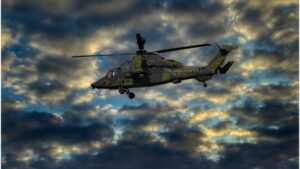





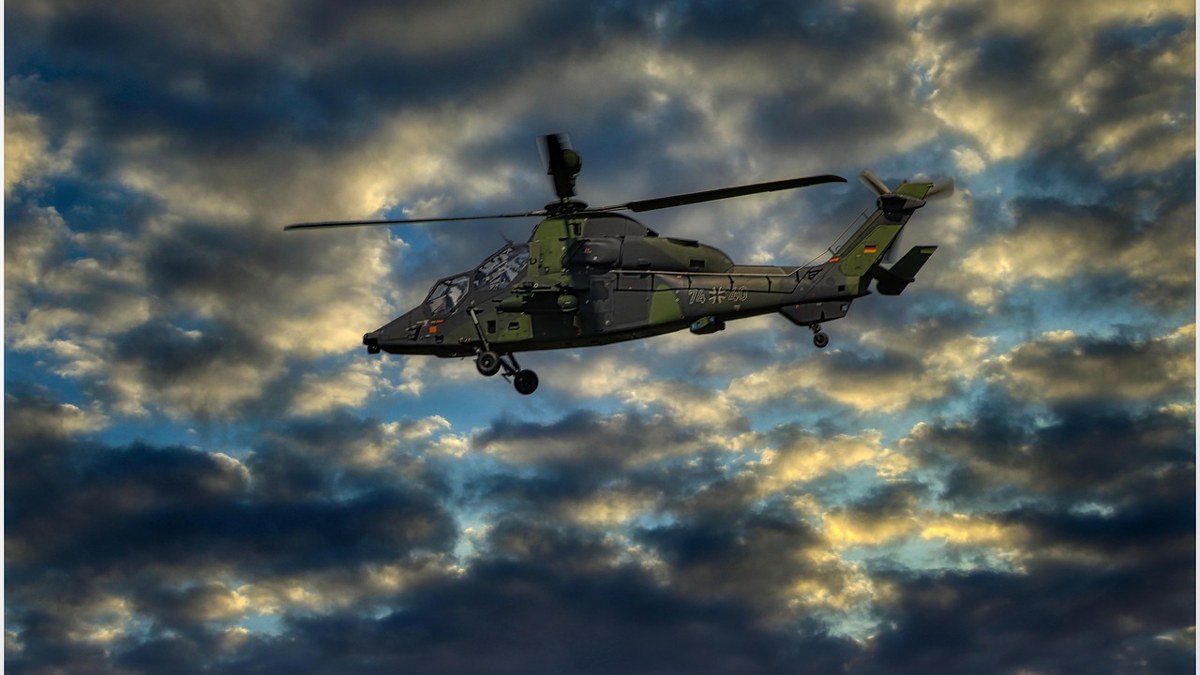
Ask a room full of people what happens when a helicopter’s engine stops and most will say the same thing: it drops like a stone. It is one of the most widely believed facts in aviation, it is repeated in films, and it is wrong. A helicopter with a dead engine does not fall. It glides, on a spinning rotor that the air itself keeps turning, and a trained pilot can put it down on a football pitch, a road or a car park with everyone on board walking away. Every helicopter pilot in the world has practised exactly this, hundreds of times, before they were allowed to carry a passenger. The manoeuvre is called autorotation, and once you understand it, helicopters stop looking like the death traps their reputation suggests.
Why the rotor keeps spinning
The blades of a helicopter are wings. They generate lift because air flows over them, and in normal flight the engine spins them so that air flows over them fast enough to hold the aircraft up. Take the engine away and something interesting happens. The helicopter starts to descend, and as it descends, air begins to flow upward through the rotor disc from below. That upward airflow hits the blades at an angle that keeps driving them round, the same way wind spins a windmill or a sycamore seed twirls to the ground. The rotor stops being something the engine pushes and becomes something the air pushes.
That is the whole trick. A spinning rotor still makes lift, whatever is spinning it. So the descent is not a fall; it is a controlled, steep glide, typically at around 1,500 to 2,000 feet per minute for a light helicopter, with the aircraft fully under control. The pilot can turn, adjust speed and pick a landing spot, and the rotor is storing energy the whole way down.
The two seconds that decide everything
Here is the part that separates a survivable engine failure from a fatal one, and it is measured in seconds. When the engine quits, the rotor is still being asked to lift the helicopter but nothing is driving it, so it starts to slow down. If it slows too far, the blades stall, the rotor can no longer be recovered, and the helicopter genuinely does fall. The pilot has roughly two seconds, sometimes less in a small helicopter, to lower the collective lever, the control that sets the blade angle, all the way down. That flattens the blades, reduces the drag on them, and lets the upward airflow take over the job of spinning the rotor.
Every helicopter pilot has that reaction drilled into them until it is a reflex. The engine note changes, a horn sounds, and the left hand is already going down before the brain has finished registering what happened. Instructors will cut the throttle without warning during training, over and over, until the student does it without thinking. It is the single most important reflex in helicopter flying.
The landing: trading spin for a soft touchdown
Gliding down is only half the problem. A helicopter descending at 1,700 feet per minute will not survive hitting the ground at that rate, so the pilot has to get rid of almost all of that speed in the last few seconds, with no engine to help. The rotor is where the answer lives. All the way down it has been spinning fast, storing energy like a flywheel. At somewhere between 40 and 100 feet, depending on the type, the pilot pulls the nose up in a flare, which slows the forward speed and briefly speeds the rotor up even more. Then, in the last few feet, they pull the collective back up. The blades bite, the stored energy in the rotor turns into a final burst of lift, and the helicopter settles onto its skids. The rotor slows to a stop a moment later, its energy spent.
Done well, the touchdown is gentler than many normal landings. Done late, the rotor runs out of energy above the ground. Done early, the helicopter stops descending too high, hangs for a moment and then drops. The timing window is a second or two, which is why pilots practise it to the ground on every training flight and on every annual check for the rest of their careers.
The chart every helicopter pilot fears
Autorotation needs two things: enough height to establish the glide, or enough forward speed to flare with. Give the pilot either and the helicopter can be landed. Take both away and it cannot, which is why every helicopter’s flight manual contains a graph that pilots call the dead man’s curve. It shows the combinations of height and speed from which a successful autorotation is not possible: too low and too slow, typically hovering between about 10 and 400 feet, or too low and too fast, skimming along at speed close to the ground.
Pilots plan their flying to stay out of that region whenever they can. It is why helicopters climb out at a shallow angle rather than straight up, why they do not hover at 200 feet for fun, and why a helicopter lifting off from a rooftop pad will often dip its nose and dive to gain speed before climbing away, a manoeuvre that looks alarming from the ground and is in fact the safest thing the pilot can do.
Why the tail rotor matters, and why losing it is worse
A single-rotor helicopter’s body wants to spin in the opposite direction to its main rotor, and the tail rotor is what stops it. Lose the engine and the tail rotor keeps turning, because it is geared to the main rotor, so the aircraft stays controllable in autorotation. Lose the tail rotor itself, through a strike or a mechanical failure, and the helicopter begins to spin; the pilot’s only fix is to cut the engine, which removes the torque causing the spin, and autorotate. So the manoeuvre is the answer to that emergency too.
Twin-engine helicopters, which is what most air ambulances, police units, offshore transports and VIP aircraft are, add another layer: if one engine fails, the other can usually keep the aircraft flying. That is why helicopters that carry passengers over water or cities are almost always twins.
So how often does this actually happen?
Engine failures in modern turbine helicopters are rare; the engines are extremely reliable and are inspected constantly. When they do happen, the record is good: the majority of engine-failure autorotations in the accident statistics end with the aircraft landed and the occupants uninjured, and many of the ones that go wrong involve the low-and-slow corner of the chart above, or a pilot who reacted late. The crashes that make the news are usually about something else entirely: flying into bad weather, hitting wires, or a mechanical failure in the rotor system itself, which is the one thing autorotation cannot help with.
The next time you see a helicopter and hear someone say it would drop like a brick if the engine stopped, you will know better. It would glide, on air alone, to a landing its pilot has rehearsed a hundred times. For a different kind of controlled descent, read what happens if both airline pilots fall asleep, and for the machines themselves, amazing facts about the UH-60 Black Hawk.
Frequently asked questions
Can a helicopter glide without an engine?
Yes. In autorotation the upward airflow through the rotor keeps it spinning, and a spinning rotor still produces lift, so the helicopter descends in a controlled glide rather than falling. Pilots practise this routinely.
How fast does a helicopter descend in autorotation?
Typically 1,500 to 2,000 feet per minute for a light helicopter, at a forward speed of roughly 60 to 70 knots. The descent is steep but fully controlled.
What is the dead man’s curve?
The height-versus-speed diagram in every helicopter’s manual showing the combinations from which a safe autorotation is not possible, mainly hovering too high to survive a drop but too low to establish a glide, or flying fast and very low.
Do helicopter pilots really practise engine failures?
Constantly. Autorotations are part of every training syllabus, every licence test and every annual check, and instructors will cut the throttle without warning to build the two-second reflex.


