






It is the question almost everyone asks on a night flight, usually while staring into a black window somewhere over the middle of a continent. There is nothing out there. No ground, no horizon, no sense of which way is up. So what, exactly, is the person at the front looking at?
The short answer: not very much, and that is on purpose.
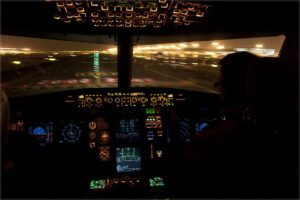
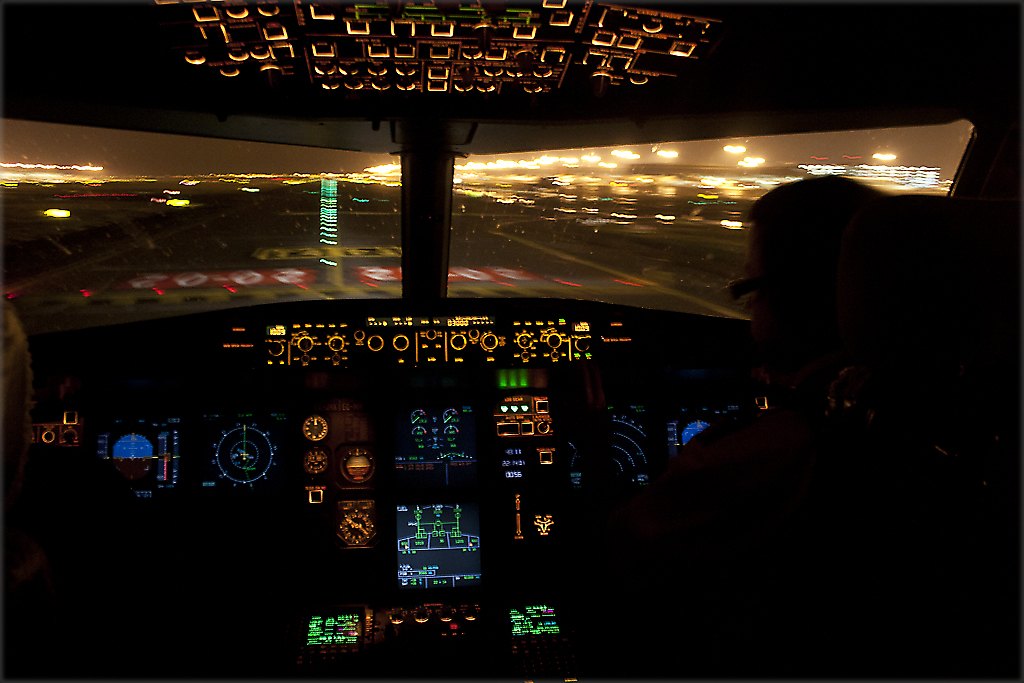
Airline pilots at night are not seeing the way passengers imagine. There is very little outside to look at, so the aircraft is flown on instruments, and the picture that matters is a standard pattern of approach and runway lights. The FAA’s own night guidance is largely a list of reasons not to trust your eyes.

Your eyes need about half an hour, and lose it in seconds
Human vision does not simply dim at night. It switches over to a different system, and the switch is slow.
The FAA’s Aeronautical Information Manual is specific about the timing. Complete dark adaptation requires exposure to total darkness for at least 30 minutes. A moderate degree can be reached in about 20 minutes under dim red cockpit lighting, which is why red light has a reputation it only partly deserves. Red badly distorts colors, especially on charts, so the AIM advises using it only where outside night vision genuinely matters, and keeping white light available for reading instruments.
The part that catches people out is how fragile it all is. Any degree of dark adaptation is lost within a few seconds of looking at a bright light. The FAA’s practical advice is almost comically low technology: close one eye when you use a light, so you keep half your night vision.
Adaptation is also degraded by things that have nothing to do with the dark. Cabin pressure altitudes above 5,000 feet impair it. So does carbon monoxide, a deficiency of vitamin A, and prolonged exposure to bright sunlight earlier the same day. A pilot who spent the afternoon on a sunlit ramp starts the night flight at a disadvantage.

The part of your eye that sees detail is smaller than you think
Even in daylight, sharp vision comes from one tiny patch at the back of the eye called the fovea. Everything else in your visual field is detected rather than resolved.
The AIM puts a number on the difference that is worth sitting with. An aircraft visible in sharp focus at 7 miles within the foveal center of vision would have to be as close as 7/10 of a mile to be recognized if it fell outside foveal vision. That is a tenfold collapse in detection range, and it applies all the time, not only at night.
That is why scanning is taught as a mechanical procedure rather than a vibe. Move the eyes in steps of no more than 10 degrees, hold each block of sky for at least one second, and keep head down time to roughly 4 to 5 seconds on the panel for every 16 seconds outside.
At night the problem compounds, because the rods that handle low light are concentrated away from the center. Look straight at a faint light and it can disappear. Look slightly to one side of it and it comes back.
What pilots are actually reading is a lighting system, not a landscape
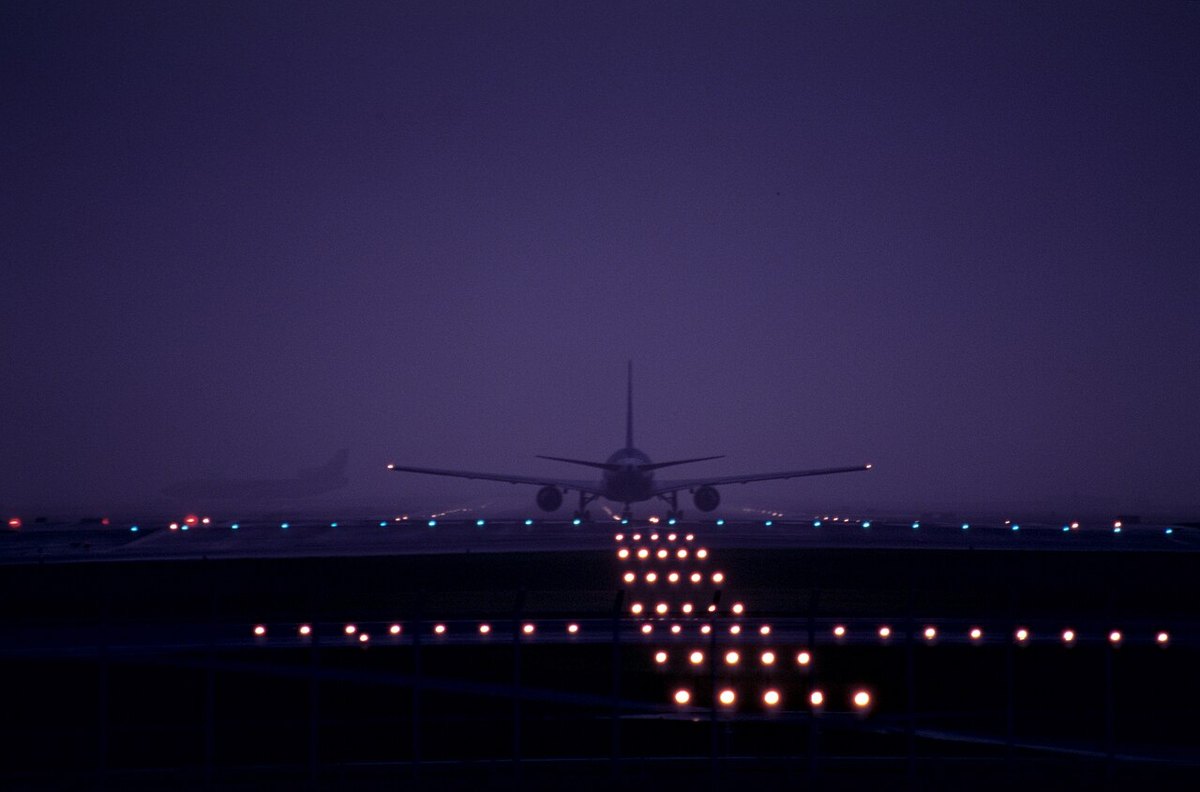
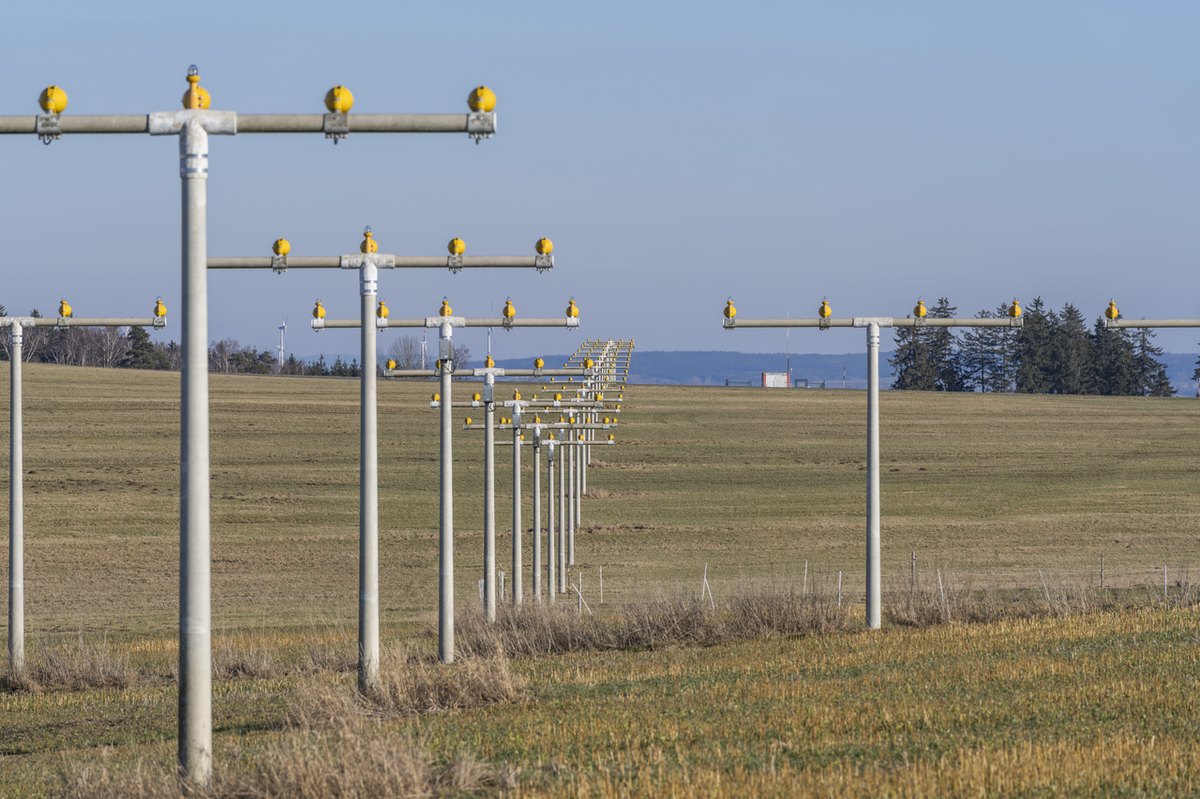
Here is the reframe that makes night flying make sense. A crew on approach is not trying to see the ground. They are trying to acquire a standardized pattern of lights that tells them, without ambiguity, where the runway is and whether they are on the correct path to it.
Approach lighting runs out from the runway threshold along the extended centerline. Runway edge lights outline the usable surface. Glide path indicators show, by color, whether the aircraft is high or low. None of this requires seeing terrain. It requires seeing a pattern and knowing what the pattern means.

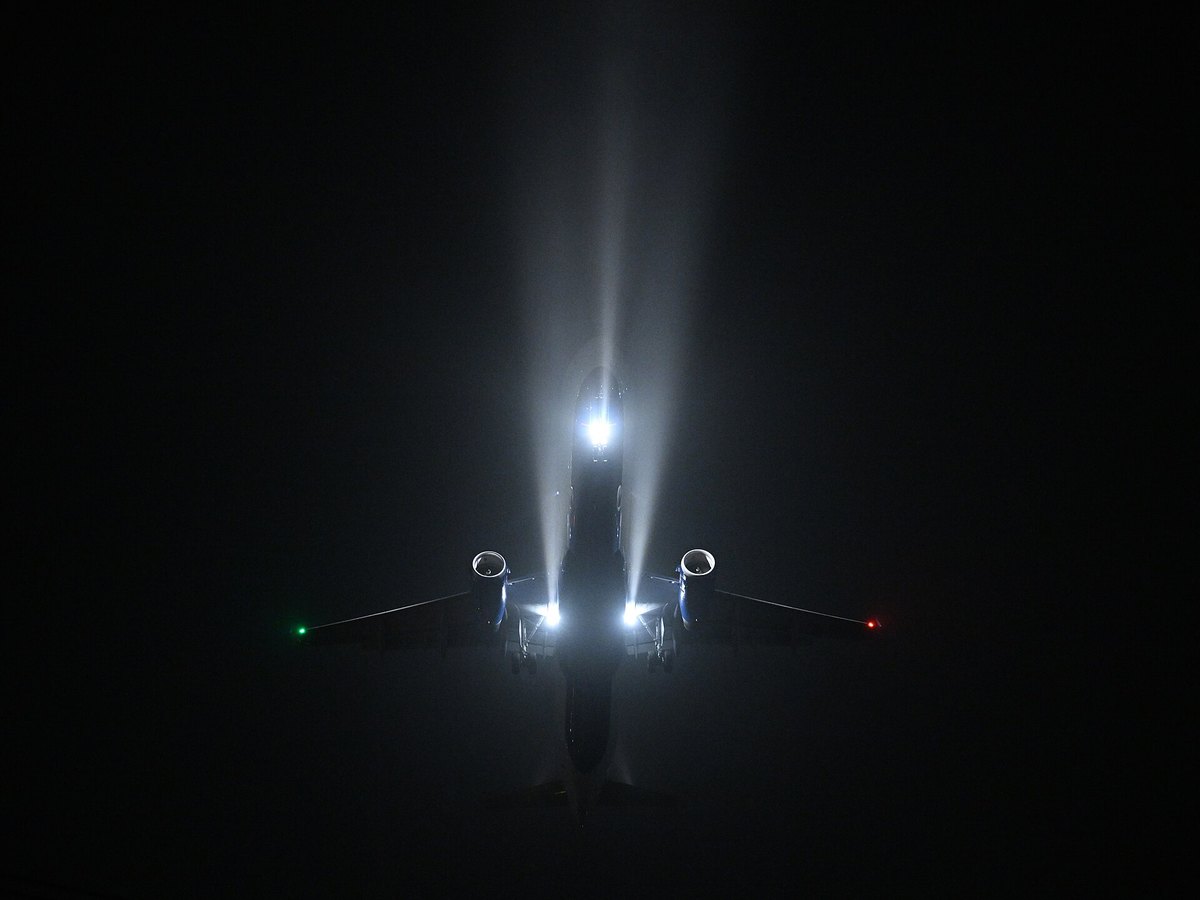
Landing lights, meanwhile, do far less than people assume. They are useful in the last stretch before touchdown and they make the aircraft conspicuous to everyone else. In cloud, fog or heavy rain they can make things actively worse, because the beam lights up the murk in front of you rather than the ground beneath you.

Four ways the eye lies after dark
The eye does not politely fail at night. It keeps reporting, confidently, and some of what it reports is wrong. The AIM lists these under illusions, and notes that illusions rank among the most common factors cited in fatal accidents.

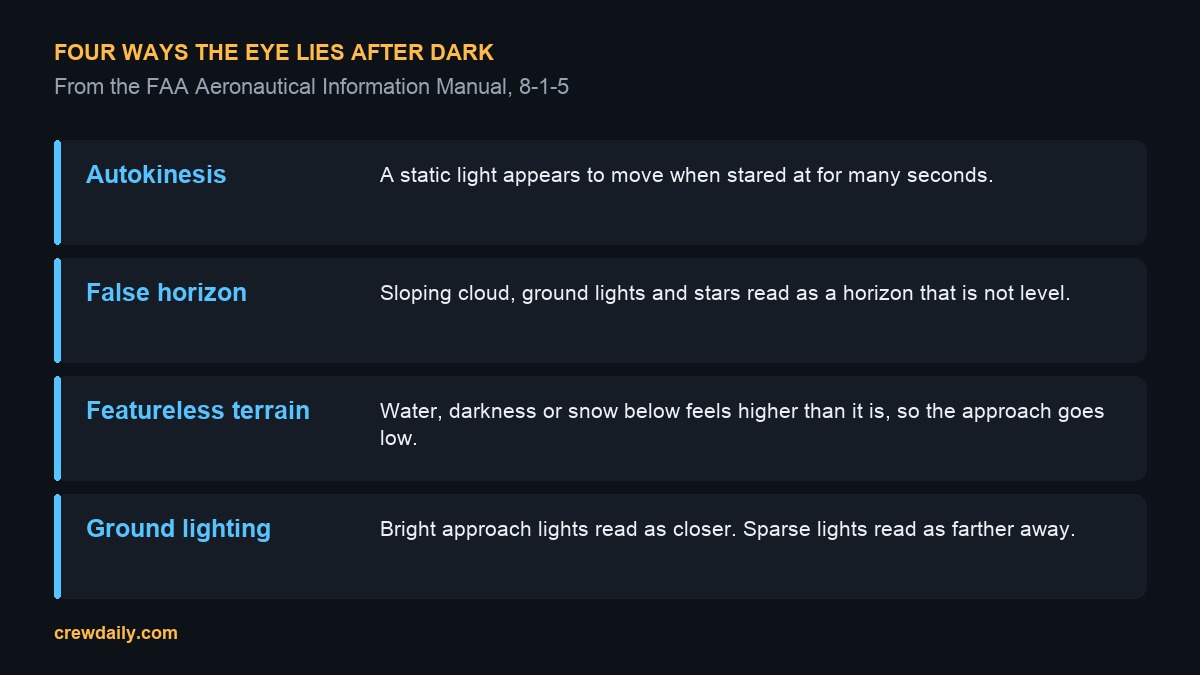
Autokinesis. Stare at a single static light in the dark for long enough and it will appear to move. A pilot who tries to align the aircraft with that wandering light can lose control of it.
False horizon. Sloping cloud, an obscured horizon, or a dark scene spread with ground lights and stars can all read as a horizon that is not where the real one is. The aircraft gets banked to match a line that does not exist.
Featureless terrain. Approaching over water, unlit ground or snow removes the cues the brain uses for height. The result is a consistent, predictable error: it feels higher than it is, so the approach is flown low.
Ground lighting. Lights along a straight road, and even lights on a moving train, have been mistaken for approach lighting. Bright approach lights surrounded by darkness read as closer than they are, so the approach is flown high. Sparse lighting reads as farther away, so the approach is flown low.
Notice the pattern. These are not failures of attention. They are the visual system working normally on insufficient data, and the defense against all of them is the same: believe the instruments.
Night has two legal definitions, and they do not line up
This is the detail that trips up even people inside aviation, and it explains why so many answers online contradict each other.
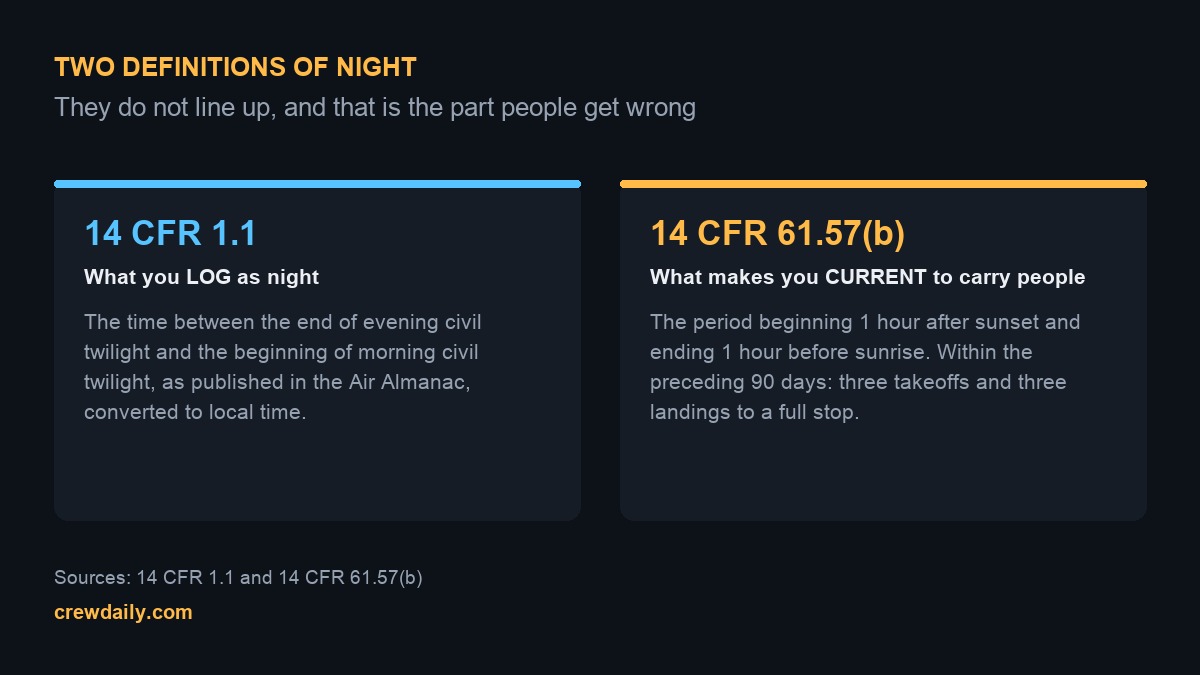
14 CFR 1.1 defines night as the time between the end of evening civil twilight and the beginning of morning civil twilight, as published in the Air Almanac and converted to local time. That is the definition used for logging night flight time.
14 CFR 61.57(b) uses a different window entirely for currency: the period beginning 1 hour after sunset and ending 1 hour before sunrise. Within that window, a pilot may not carry persons unless, in the preceding 90 days, they have made at least three takeoffs and three landings to a full stop in that same window, as sole manipulator of the controls, in an aircraft of the same category, class and type.
Two things follow from the exact wording. Touch and goes do not count, because each landing must be to a full stop. And the restriction is about carrying people, not about flying: a pilot who has let night currency lapse can still fly alone at night, including the three landings that restore it. The requirement can also be met in an approved full flight simulator with the visual system set to represent night.
If currency rules are the part you care about, we went through the wider version of this in how long a pilot stays current and what the 90 day rule actually requires.
Who is allowed to fly at night in the first place
The autosuggest questions here are blunt and so are the answers.
Private pilots can. The training is specified in 14 CFR 61.109(a)(2): three hours of night flight training in a single engine airplane, including one cross country flight of over 100 nautical miles total distance and 10 takeoffs and 10 landings to a full stop, each involving a flight in the traffic pattern.
Sport pilots cannot. 14 CFR 61.315(c)(5) prohibits it outright, subject to the narrow provision in 61.329. That flat answer is why the question keeps appearing in search.
Student pilots operate under the limitations on their certificate and their instructor’s endorsements, which is a separate tangle we unpicked in what a student pilot certificate actually lets you do.
What about night vision goggles
Goggles are real, and they are mostly not an airline thing. They belong to military flying and to specialist civil work such as helicopter emergency medical services.
Using them requires its own training and a logbook endorsement under 14 CFR 61.31(k). The interesting part is what the required ground training has to cover: how to protect night vision, how the eyes adapt to night, self imposed stresses that affect night vision, the effects of lighting on night vision, the cues used to estimate distance and depth perception at night, and visual illusions.
Read that list again. The regulator’s own syllabus for the technology that improves night vision is, in large part, an inventory of the ways human night vision fails.
So what is the pilot actually doing out there
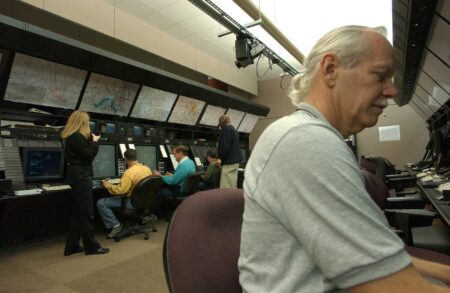
Flying the instruments, cross checking them against each other, following a route that was agreed before departure, talking to controllers who are watching the same aircraft on radar, and waiting for one specific pattern of lights to appear in roughly the place the instruments say it should be.
The darkness outside is not a problem to be solved by looking harder. It is the normal condition, and the entire system is built on the assumption that nobody can see.
If the human side of long night sectors interests you, the related questions are how long a pilot is actually allowed to fly and what happens if both pilots fall asleep.
Frequently asked questions
How do pilots see at night?
Mostly they do not rely on seeing. The aircraft is flown by reference to instruments, and the visual task is acquiring a standard pattern of approach and runway lights rather than looking at terrain.
Can pilots see at night better than other people?
No. They have the same rods and cones as everyone else. What they have is training in how to use them, including off center viewing, a disciplined scan, protection of dark adaptation, and the habit of believing the instruments over the eyes.
How long does it take to adapt to the dark?
Complete dark adaptation requires at least 30 minutes in total darkness, according to the FAA. About 20 minutes under dim red lighting gives a moderate degree. Any of it is lost within a few seconds of looking at a bright light.
Is it harder to fly at night?
The flying itself is often smoother, with less traffic and calmer air. The hazards shift: fewer visual cues, a higher risk of visual illusions on approach, and terrain that cannot be seen. That is why night currency is regulated separately.
Can a private pilot fly at night?
Yes, after the night training in 14 CFR 61.109(a)(2). Carrying passengers at night additionally requires meeting the 90 day currency rule in 14 CFR 61.57(b).
Can a sport pilot fly at night?
No. 14 CFR 61.315(c)(5) prohibits sport pilots from flying at night, except as provided in 61.329.
Do airline pilots use night vision goggles?
Generally no. Goggles are used in military aviation and in specialist civil operations such as helicopter emergency medical services, and they require separate training and an endorsement under 14 CFR 61.31(k).
Sources
- FAA Aeronautical Information Manual, Chapter 8 Section 1, paragraphs 8-1-5 Illusions in Flight and 8-1-6 Vision in Flight.
- 14 CFR 1.1, definition of night.
- 14 CFR 61.57, recent flight experience, paragraph (b).
- 14 CFR 61.109, aeronautical experience for a private pilot certificate.
- 14 CFR 61.315, sport pilot privileges and limits.
- 14 CFR 61.31(k), additional training for night vision goggle operations.