
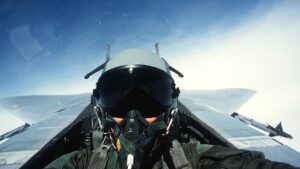





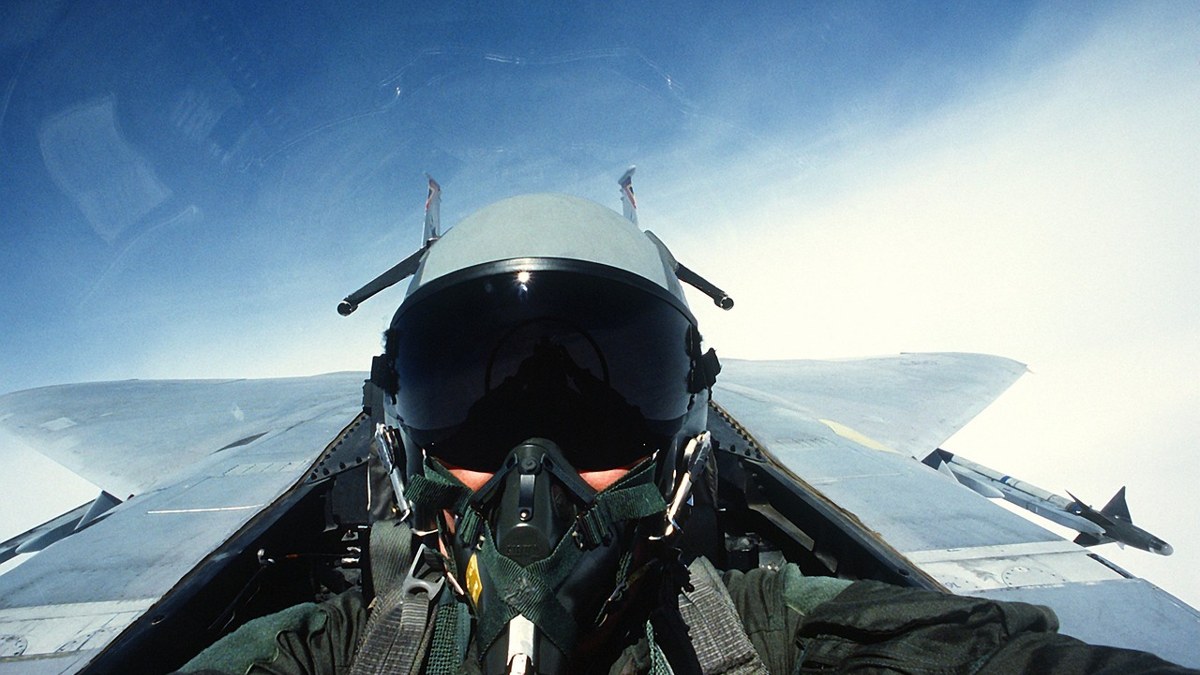
Pull the stick back hard in a modern fighter and, within about a second, everything you own weighs nine times what it did. Your head, with helmet, goes from roughly 6 kg to more than 50. Your arms are too heavy to lift off your lap. The blood in your body, which has no idea it is in an aeroplane, does exactly what nine times gravity tells it to do: it drains out of your head and pools in your legs. Roughly four to five seconds later, if you do nothing about it, you lose your vision, then your hearing, then consciousness, while the aircraft carries on at 800 km/h with nobody flying it.
Fighter pilots pull 9g routinely, sometimes several times in a single fight, and walk away from it. Here is what is actually happening inside their bodies when they do, and the strange, physical, half-athletic trick that keeps them awake.
What “g” actually means
One g is the pull of gravity you feel sitting in a chair. In a tight turn or a hard pull-up the aircraft accelerates towards the inside of the turn, and the pilot feels it as extra weight pressing them down into the seat. At 2g you weigh twice as much. At 9g, the certified limit for an F-16 or a Eurofighter, a 90 kg pilot is pushing down on the seat with more than 800 kg of force.
The number that matters is not the peak but the direction. Fighter g is “positive g”, head-to-foot, and it is dangerous for one reason: the heart is a pump designed to push blood about 30 cm uphill to the brain against one g. Ask it to do that against nine and it simply cannot. Blood pressure at eye level falls to zero within a few seconds.
The sequence, second by second
- Grey-out. The eyes are the first to go, because the retina is the most blood-hungry tissue in the body and it sits above the heart. Colour drains out of the world. Pilots describe it as someone turning the saturation down.
- Tunnel vision. The edges of the visual field go dark and close inwards. Instruments in the centre are still readable; anything peripheral is gone.
- Black-out. Total loss of vision. The pilot is still conscious and can still hear and feel the aircraft, but is flying blind.
- G-LOC. G-induced loss of consciousness. The brain’s oxygen reserve is exhausted, the pilot goes limp, and the jet flies itself into whatever is in front of it. Recovery takes 15 to 30 seconds, followed by a period of confusion in which the pilot often has no idea they were ever unconscious. At low altitude that is a fatal combination, and G-LOC has killed more fighter pilots than most people realise; the US Air Force alone has lost dozens of aircraft and pilots to it.
The whole sequence, from a hard pull to the lights going out, can take under six seconds. That is the problem the entire g-protection system is built to solve.
The suit that squeezes your legs
The most famous piece of the answer is the g-suit: a pair of trousers with inflatable bladders over the calves, thighs and abdomen, plugged into the aircraft’s air system. As g builds, the suit inflates automatically and squeezes the lower body, physically stopping blood from pooling in the legs. It is not comfortable. Pilots compare it to being gripped by a very strong pair of hands.
Here is the number that surprises people: a g-suit only adds about 1 to 1.5g of tolerance. On its own it does not get anyone to 9g. Some of the world’s most demanding aerobatic pilots fly without one at all. The US Navy’s Blue Angels do not wear g-suits, because the inflating bladders would nudge the control stick during the formation flying that puts their wingtips within a metre of each other. They pull up to 7g on muscle alone.
The real trick: a breathing technique that looks like a fight
What actually keeps a pilot conscious at 9g is something called the anti-g straining manoeuvre, or AGSM, and it is entirely physical. Just before and during the pull, the pilot tenses every muscle in the legs, buttocks and abdomen as hard as they can, which squeezes the blood vessels shut and forces blood back up towards the chest. At the same time they take a deep breath, close the throat, and strain against it, the way you would lifting something far too heavy, which raises pressure inside the chest and pushes the heart’s output upward. Every three seconds they let a short, sharp breath out and in, “hick” is the sound instructors teach, and go straight back to straining.
Do it correctly and a fit pilot in a g-suit can hold 9g for the length of a turn. Do it slightly wrong, breathe out for a fraction too long, relax the legs for a moment, and vision starts to close in almost immediately. It is exhausting in a way that is hard to convey: a dogfight is a series of maximum-effort isometric holds, performed while thinking tactically, in a helmet that weighs the same as a small child, with a heart rate that would not look out of place in a sprint.
Pilots learn it in a centrifuge before they ever go near a fighter. Trainees are spun to increasing g while an instructor watches their face on camera; the videos of trainees failing the manoeuvre, going slack-jawed and then jerking awake with no memory of it, are a rite of passage and a sobering one.
Why the seat leans back
Look at an F-16 cockpit and the seat is reclined at 30 degrees, far more than in any other fighter of its generation. That was not for comfort. Leaning the pilot back reduces the vertical distance between heart and brain, which is the distance the blood has to climb. It is worth roughly an extra g of tolerance, which is why the F-16 was the first aircraft to be built for sustained 9g, and why later designs have followed with reclined seats and raised rudder pedals that lift the legs.
What it does to the body over a career
Nobody pulls 9g for twenty years without paying for it. The best-documented cost is the neck: a helmet with night-vision goggles and a mounted display can weigh 2 kg or more, which at 9g becomes an 18 kg load hanging off the cervical spine while the pilot cranes to look over their shoulder at an opponent. Chronic neck and back pain is close to universal in the fighter community and a common reason pilots stop flying fast jets. Air forces now put pilots through dedicated strength programmes, and some squadrons employ physiotherapists full time.
Other effects are stranger. Small burst blood vessels in the skin, “g-measles”, appear on the forearms and back after a hard sortie, because negative or rapidly changing g pushes blood into places it should not be. Pilots routinely lose a litre or more of fluid in sweat during a fight, which lowers g-tolerance further, so hydration is treated as a safety issue, not a comfort one. And the one thing that reliably wrecks g-tolerance is a hangover, which is why fighter squadrons have a stricter relationship with alcohol than their reputation suggests.
Why aircraft can do more than pilots
The airframe of a modern fighter can take far more than 9g; the limit is set by the person in it. This is one of the quieter arguments in the debate over uncrewed combat aircraft: a drone has no blood to pool, no neck to crush and no brain to starve. Remove the pilot and the g-limit becomes a structural question rather than a physiological one. For now, though, the most sophisticated g-protection system in any fighter is still a human being clenching every muscle they have and breathing in three-second bursts.
For the other side of the physical story, see our piece on famous ejections in aviation history, where the g-load is measured in a fraction of a second and 14g is considered a gentle ride, and the F-22 versus F-35 comparison for what the aircraft themselves can do.
Frequently asked questions
How many g can a fighter pilot pull?
Modern fighters such as the F-16, F-22, Eurofighter and Rafale are certified to 9g. Trained pilots with a g-suit and the anti-g straining manoeuvre can sustain that for the length of a turn; without either, most people lose consciousness somewhere between 4 and 6g.
What is G-LOC?
G-induced loss of consciousness: the brain runs out of oxygenated blood under sustained positive g and the pilot passes out, typically for 15 to 30 seconds, followed by a period of confusion. It has caused numerous fatal fighter accidents.
Do the Blue Angels wear g-suits?
No. The inflating bladders would disturb the control stick during close formation flying, so the team relies on physical conditioning and the straining manoeuvre alone, at up to about 7g.
Why is the F-16 seat reclined?
The 30-degree recline shortens the vertical distance between the heart and the brain, which raises g-tolerance by roughly one g and helped make the F-16 the first fighter designed for sustained 9g.


