


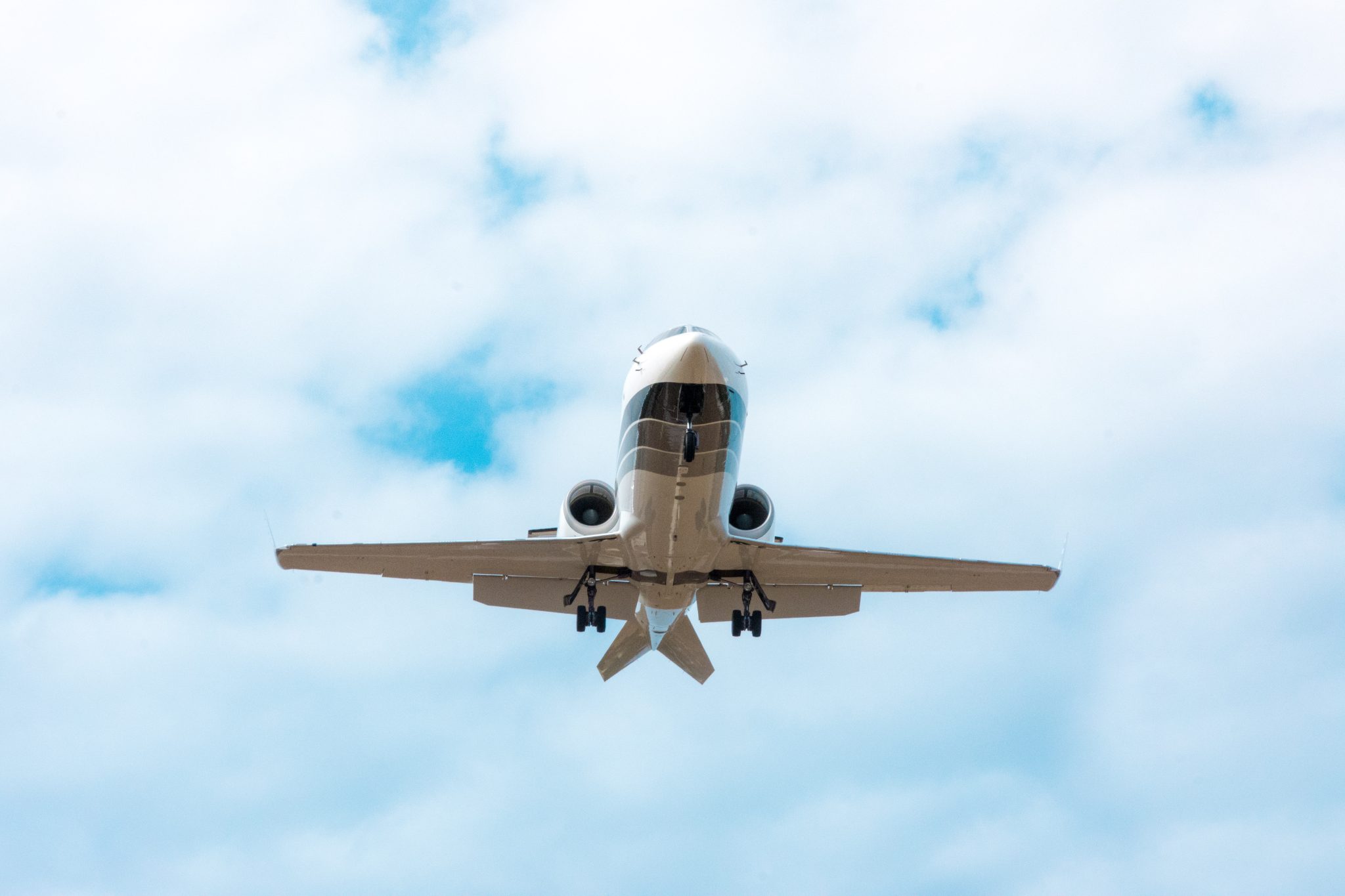
A four-kilogram goose weighs about as much as a bag of sugar. Hit one at 250 knots and it arrives at an aircraft with roughly the force of a small car dropped from a first-floor window. Bird strikes are reported many times a day worldwide, the United States alone recorded about 24,500 at 870 airports in 2025, and the overwhelming majority of them end with a dent, a cleaning job and a flight that carries on as normal. Occasionally one ends in the Hudson River. Here is what actually happens when a bird meets an airliner, what engines are built to swallow, and why the problem is getting worse rather than better.
The physics: it is speed, not the bird
People assume a large bird is dangerous because it is heavy. It is dangerous because the aircraft is fast. Impact energy rises with the square of the speed, so the same gull that bounces harmlessly off a taxiing aircraft can crack a windscreen at rotation. A 1.8 kg bird struck at 250 knots delivers an impact force in the region of 10 tonnes, spread over a few thousandths of a second.
That is also why strikes cluster low and slow in a flight. The FAA’s own figures put about 70 percent of strikes between the ground and 500 feet above ground level, with about 61 percent in the landing phases, 36 percent on the take-off run and climb, and 3 percent en route (FAA wildlife strike FAQ). High altitude strikes are genuinely rare: the same source records 35 strikes with commercial aircraft between 20,000 and 32,000 feet across the 35 years from 1990 to 2025.
What the aircraft is built to take
Nothing about this is a surprise to the people who designed the aeroplane. Certification rules require it:
- Windscreens must withstand a 1.8 kg (4 lb) bird without penetration at VC, the design cruising speed at sea level, which is faster than approach speed and is the figure the rule actually names (14 CFR 25.775(b)). Manufacturers test this with a compressed-air cannon, firing bird carcasses at the glass. The device is universally known as the chicken gun, and yes, the birds are thawed first, because a frozen one is effectively a cannonball and gives meaningless results.
- The empennage must be designed so that the aeroplane can continue safe flight and landing after impact with a 3.6 kg (8 lb) bird at VC at sea level (14 CFR 25.631).
- Engines face the harshest rules of all, because an engine both catches birds and spins at high rpm while doing it. The large bird ingestion test fires one bird, sized from the engine inlet area, at 200 knots (14 CFR 33.76).
The engine tests are the brutal part
Before a jet engine is certified it has to pass a series of ingestion tests that are, frankly, extraordinary to watch:
- Small bird ingestion: a volley of small birds fired into the running engine; it must keep producing thrust.
- Medium bird: multiple birds of around 1 kg; the engine may lose some thrust but must not fail dangerously.
- Large single bird: a bird of up to 3.65 kg, depending on inlet size, fired into the engine at take-off power. The engine does not have to keep running, but it must shut down without throwing debris through its casing, catching fire or breaking its mounts. This is called a contained failure, and it is the whole point.
- Fan blade off: separately, engineers deliberately detonate a fan blade at full power to prove the casing holds. It is the single most expensive test in the programme, and manufacturers only get to do it once per design.
What no engine is certified for is a flock of large birds down both engines at once. That is precisely what happened to US Airways 1549 in January 2009, when a flight of Canada geese took out both CFM56s at 2,800 feet, and why the aircraft ended up in the Hudson. Both engines had passed every test; the birds simply exceeded the standard.
What the crew actually does
There is no dramatic “bird strike procedure.” If a strike is felt or heard, the crew handle whatever the consequence is: an engine failure is flown as an engine failure, a cracked windscreen as a depressurisation risk, a damaged nose as an air-data problem. Most commonly, they feel a thud, see nothing abnormal on the instruments, and continue. On landing, engineers inspect the airframe and engines, and if blood or feathers are found (the remains are collected and sometimes DNA-tested, in the US by the Smithsonian, to identify the species) the aircraft may be grounded for hours while blades are borescoped.
The costs are real: global damage and delay from bird strikes runs into the billions of dollars a year, and a single ingested goose can mean an engine change.
How airports fight back
Every significant airport runs a wildlife management programme, and they are more inventive than most passengers imagine:
- Habitat first. The cheapest defence is making the airfield boring: grass kept at a specific length that geese dislike, no standing water, no berry-bearing trees, no landfill nearby.
- Noise. Gas cannons, distress-call broadcasters and pyrotechnic bangers, rotated constantly, because birds habituate to anything predictable within days.
- Falconry. Several major airports employ falconers full-time; a live hawk is the one deterrent birds do not get used to.
- Radar. Avian radar systems track flocks in real time and warn controllers, letting them hold a departure for ninety seconds rather than fly into a flock.
- Dogs, lasers, drones and, at some airports, border collies that patrol the grass.
Why it is getting harder
Two trends are pulling in the wrong direction. Conservation has been a success story: populations of exactly the large, flock-forming species that damage aircraft, Canada geese, snow geese, cormorants, cranes, have grown enormously in North America and Europe over the past forty years. At the same time, engines have grown: a modern high-bypass fan has a far bigger intake than a 1960s turbojet, presenting a much larger target.
Which leads to the uncomfortable question about the next generation of aircraft. Electric and hybrid designs, and the autonomous fighters now being ordered in numbers, use smaller, more numerous rotors and fans; nobody yet knows how those behave with a goose in them. Certification standards written around two big engines will have to be rewritten.
For now, the honest summary is the reassuring one: bird strikes are common, aircraft are designed and tested for them, crews train for the consequences, and the events that make the news are the rare cases where a flock beat a standard that has otherwise worked for decades. For another everyday hazard people misunderstand, read what a black box actually records, and for what happens when the engines really do stop, how a helicopter lands with no engine at all.
Frequently asked questions
How often do bird strikes happen?
Very often. The FAA counts about 344,000 reported wildlife strikes with civil aircraft in the United States between 1990 and 2025, including about 24,500 at 870 airports in 2025 (FAA wildlife strike FAQ). The vast majority cause no damage.
Can a bird bring down an airliner?
A single bird almost never does. The danger is a flock hitting multiple engines at once, as with US Airways 1549 in 2009. Aircraft are certified to survive single strikes on windscreens, structure and engines.
What is the chicken gun?
The compressed-air cannon used to fire bird carcasses at windscreens, engines and airframes during certification testing. The birds are thawed, not frozen, so the test represents a real strike.
What happens to the aircraft after a bird strike?
It is inspected on landing. If damage or remains are found, engines are borescoped and parts may be replaced; in the US the remains are often sent for DNA identification of the species to improve airport wildlife programmes.
Why do most bird strikes happen at airports?
Because strikes cluster where aircraft and birds share the same low airspace. On the FAA’s figures about 70 percent happen between the ground and 500 feet, and about 61 percent in the landing phases.
