





Aloha Airlines flight 243 lost about eighteen feet of its upper fuselage at 24,000 feet on 28 April 1988, and landed at Kahului with 94 of the 95 people on board. The NTSB found no single broken part. The cause was a maintenance programme that did not detect disbonding and fatigue damage in one lap joint, a bonding process that had been giving trouble since the 1960s, and an inspection order that covered a different joint.
What happened on 28 April 1988
The aircraft was a Boeing 737-200, registration N73711, the 152nd 737 off the line. It was working inter-island flights in Hawaii. According to the FAA’s account of the accident, the first officer walked around the aircraft before the first flight of the day in pre-dawn darkness and found nothing unusual, and the same crew then flew three round trips out of Honolulu. The airline did not require the flight crew to inspect the aircraft between flights, and none were done.
Flight 243 left Hilo for Honolulu at 13:25. As it levelled at 24,000 feet, an explosive decompression took the upper crown skin away. The NTSB records that approximately 18 feet of cabin skin and structure separated from the aircraft in flight, from just aft of the main cabin entrance door and above the passenger floor line. One flight attendant, who had been standing at row 5, was swept overboard and is presumed to have been fatally injured. Seven passengers and one flight attendant were seriously injured. The captain took over from the first officer, flew an emergency descent, and landed on Maui.
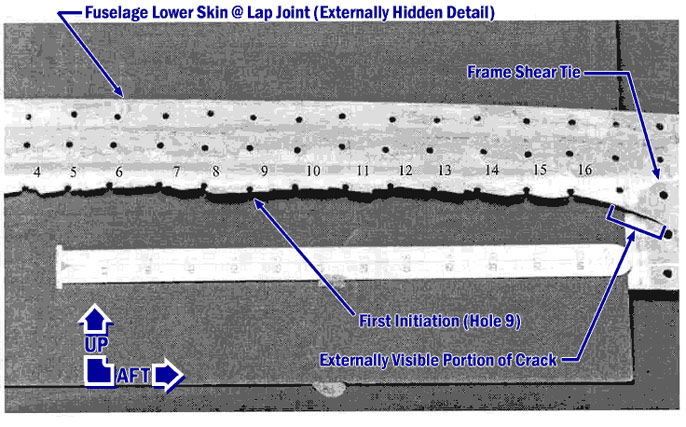
There is a detail in the FAA’s record that is easy to read past. After the accident, a passenger said that as she boarded she had seen a longitudinal crack in the fuselage, in the upper row of rivets along the lap joint, roughly halfway between the cabin door and the jet bridge hood. She did not mention it to the crew before takeoff. The crack that opened the aircraft was visible from the apron to anyone who happened to look at the right three feet of aluminium.
The Board stated its finding in one sentence, and it names a programme rather than a part:
The National Transportation Safety Board determines that the probable cause of this accident was the failure of the Aloha Airlines maintenance program to detect the presence of significant disbonding and fatigue damage which ultimately led to the failure of the lap joint at S-10L and the separation of the fuselage upper lobe.
It then listed three contributing factors: Aloha management’s failure to supervise its maintenance force properly and to assess the airline’s inspection and quality control deficiencies, the FAA’s failure to broaden its inspection order to all the lap joints as Boeing’s alert bulletin had proposed, and the absence of any complete terminating action after the early production difficulties with the cold bond joint were discovered. Each of those is a decision rather than a defect, which is what the rest of this comes down to.
The joint that failed, and why it was built that way
A pressurised fuselage is a tube made of panels, and the panels have to be joined. On the 737 the longitudinal join is a lap splice: the skin of the upper panel overlaps the edge of the lower panel by about three inches, and the two are fastened with three rows of rivets.
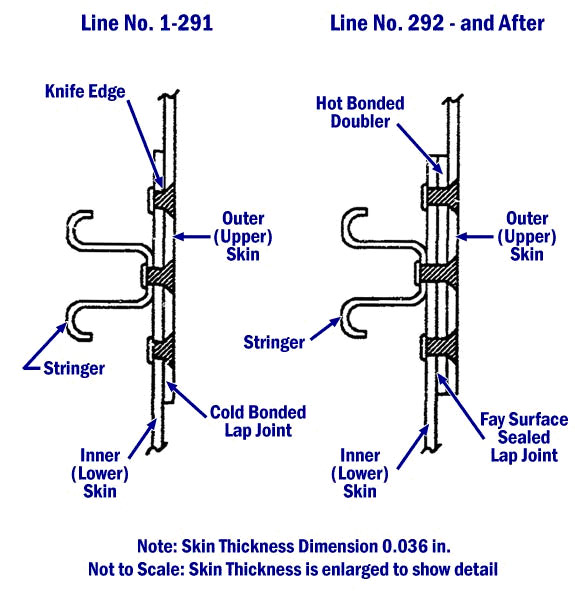
On early 737s, up to line number 291, the overlap was also glued. The design intent was that the hoop loads from pressurisation would pass through the adhesive bond across the whole overlap, and not through the rivets. That is a reasonable idea. A bonded joint spreads load over an area, while a riveted joint concentrates it at holes, and holes are where fatigue cracks start.
The adhesive was a cold bond: a cloth scrim impregnated with glue that cures at room temperature, which means it has to be kept at dry ice temperature until shortly before it is used or it starts curing in storage. The FAA lists three difficulties that came with that process in production: the quality of surface preparation, condensation getting into the joint during assembly, and premature curing of the adhesive. The result was not a uniform failure. It was randomness. Some bonds came out fine, some came out weak, some areas were vulnerable to corrosion, and some did not bond at all.
Once a patch of bond has failed, water wicks into the gap, corrodes the aluminium, and lifts more of the bond. Disbonding spreads.

How a good design assumption turns into a bad one
The important consequence is what happens to the load. If the adhesive is no longer carrying the hoop load, the rivets are, and the rivets were never meant to. Worse, the countersink for each rivet head on these joints went through the entire thickness of the upper skin, leaving a knife edge at the hole rather than a flat seat.
So the load went where it was not designed to go, into holes with an unusually sharp stress concentration. Cracks started at many neighbouring rivet holes at once. The FAA calls this Multi-Site Damage, and describes its insidious feature plainly: a large number of small, hard to detect cracks can link up rather suddenly into one long critical crack. In its advanced stages, which is what this aircraft had, the condition becomes Widespread Fatigue Damage, where the structure can no longer carry the residual strength loads it is certified to carry.
This is the part that makes the accident an engineering story rather than a freak event. Nothing on the aircraft had to break unexpectedly. The joint failed by doing exactly what the physics said it would do once the glue stopped working, and the glue had been known to stop working for eighteen years.

The service history was not a secret
Lap joint corrosion in service was first reported in 1970. Boeing issued a service bulletin that year to seal the joints against corrosion, which helped only partly, and sealing went into production from line number 249. The cold bond joint was dropped from production in 1972, and from line number 292 a redesigned joint was fitted: thicker, with the rivets carrying the pressurisation loads and the adhesive no longer used for load transfer. That is a clear admission of what the original joint could not be relied on to do.
Reports of tear strap disbonding started in 1974. Tear straps are the circumferential bands meant to stop a crack running, so that a rupture turns into a flap of skin and a survivable decompression rather than an unzipping. A 1974 revision to the service bulletin added inspection for fatigue cracks in the lap splices, at a point when fatigue cracking had not actually been seen in service yet.
By 1987 it had been. The bulletin was revised again and upgraded to alert status, because cracks had now been found in service at stringers S-4L, S-4R, S-10R and S-14R.

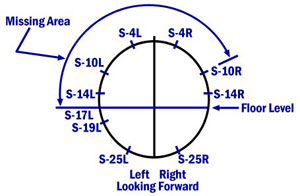
The bulletin said inspect the joints. The directive said inspect one of them.
In 1987 the FAA turned part of that alert bulletin into law, as Airworthiness Directive 87-21-08. The bulletin provided for inspecting the lap splices at stringers S-4, S-10, S-14, S-19, S-20 and S-24, left and right. The directive mandated S-4 left and S-4 right only.
At the public hearing an FAA employee explained the reasoning: the choice was based on the statistical information available, which indicated the S-4 joint was the more likely one to crack, and on the scope of work that a wider mandate would have required. That is a defensible way to ration inspection effort, and it was a judgement rather than an oversight.
The joint that failed on flight 243 was S-10 left. Cracks had already been found at S-10 on the right hand side of other aircraft, and that stringer was in the bulletin and not in the directive. The NTSB listed the FAA’s failure to broaden the directive to all the lap joints as a contributing factor to the accident.
There is a second finding that is harder to look at. The S-4R joint on this aircraft had been inspected and repaired under the directive, as required. When investigators examined it afterwards, they found cracks growing from the top row of rivet holes, and the analysis concluded those cracks would have been detectable by the eddy current inspection the directive called for, at the time that inspection was carried out. Aloha’s training records showed little formal instruction in non-destructive inspection, and the paperwork was not there, so whether the eddy current checks were done badly or simply not done cannot be established.
The inspection clock was measuring the wrong thing
Here is the finding that should change how anyone reads a maintenance schedule. Aloha’s heavy maintenance check, the D-check, was set at an interval of 15,000 flight hours. Boeing’s recommendation was 20,000. On paper the airline was inspecting its aircraft more often than the manufacturer asked.
It did not help, because flight hours were the wrong unit. Aloha flew very short inter-island hops, so its aircraft accumulated pressurisation cycles at roughly twice the rate Boeing had assumed when it wrote the recommendation. In a pressurised fuselage, crack initiation and crack growth are driven by cycles, not by hours, because each cycle is one inflation and deflation of the tube. N73711 had 89,680 flight cycles against 35,496 flight hours. Both numbers are from the FAA’s record of the accident, and the ratio between them is the whole problem: an average flight of well under half an hour.
The FAA’s own assessment is that this was not sufficiently taken into account when Aloha’s maintenance programme was written and then approved by the FAA, and that some tasks should have been done more frequently. A schedule can be stricter than the manufacturer’s and still be far too loose, if it is counting the wrong events. If you want a sense of what the routine end of that work looks like now, our explainer on what a daily aircraft maintenance check actually covers goes through it.
There was a structural problem with how the check was carried out as well. Boeing’s planning document envisages a D-check as a continuous event, with the aircraft out of service for a few weeks. Aloha divided it into 52 separate work packages, and put parts of the D-check into overnight B-checks. The NTSB called that an inappropriate way to assess the overall condition of an aircraft, and observed that it was obvious to the maintenance and inspection staff that every aircraft would be needed in fully operational status for the next day’s schedule.
When the rest of the Aloha 737 fleet was inspected after the accident, swelling and bulging skin, dished fastener heads, pulled or popped rivets and blistering, scaling and flaking paint were found along the lap joints of almost every aircraft. The NTSB’s conclusion on that point is the one worth remembering: pilots and line maintenance staff had come to accept the classic signs of ongoing corrosion damage as a normal operating condition. Two more aircraft in the fleet were later judged beyond economical repair and sold for parts and scrap, and N73711 was scrapped.
The assumption that removed the inspection
One more piece explains why nobody was told to go looking for cracks in that skin at all. In 1978 the fail-safe requirements of the certification rules were amended to add damage tolerance requirements using fracture mechanics. Aircraft certified before that amendment were covered instead by a Supplemental Structural Inspection Program, and the 737’s was to be in force by November 1985.
When that programme was written, structure was sorted into what needed a new directed inspection and what did not. Anything considered damage obvious or malfunction evident was left out, on the reasoning that you do not need a special inspection to find a problem that announces itself. Minimum gage fuselage skin was excluded on exactly that basis: a crack would be arrested at a tear strap, the skin would flap, and the decompression would be controlled and obvious.
Tests and fleet history had appeared to support that. The FAA now lists it among the safety assumptions that proved to be flawed. The flapping model assumes one crack. Multi-Site Damage produces many, and when many link up, the crack that results is longer than the tear straps can arrest.
What changed
The accident is the reason the industry treats ageing aircraft as its own discipline. Mandatory corrosion control programmes followed, requiring operators to run prevention and inspection systems sufficient to ensure hazardous corrosion does not occur in the first place. A long series of airworthiness directives followed too, covering longitudinal and circumferential fuselage joints, corrosion inspections and supplemental inspection of the whole structure, and in 2002 two directives mandated removal and replacement of certain areas of the skin lap splice outright, rather than more looking at it.
The certification rule itself was amended to require special consideration of Widespread Fatigue Damage, with the demonstration standard being full scale fatigue test evidence that it will not occur within the aircraft’s design service goal. There is now a repair assessment rule for pressurised fuselages, and a dedicated Widespread Fatigue Damage rule. The NTSB had also recommended that future turbojet transports be fatigue tested to at least twice their projected economic service life, that existing ones not tested to two lifetimes be tested, and that manufacturers then identify structure prone to multiple site damage and write inspections able to find it.
The recommendations about people are as important and get quoted less. They asked for maintenance technician certification and training to cover modern industry technology, for operators to train inspection staff in the conditions under which a visual inspection has to be performed, for personnel to be tested periodically on whether they can actually detect defined defects, and for safety inspection programmes to look at the real condition of aircraft on the ramp and in the hangar rather than only at the paperwork trail.
Could it happen now
The specific failure is closed off. The cold bond joint was out of production in 1972, the surviving aircraft with it have been through mandated replacement of the affected skin areas, cycles rather than hours drive the inspection intervals that matter, and widespread fatigue damage is something a manufacturer now has to rule out by test for the service life it claims.
What has not closed is the general shape of the thing, which is a chain where each link looks reasonable alone. A joint designed around a bond, a bond that fails randomly, a redesign that fixes future aircraft and not existing ones, a bulletin broader than the directive that enforced it, an inspection interval in the wrong unit, and a paperwork culture that had learned to see corrosion as normal. Any one of those is survivable. Together they took the roof off an airliner.
Modern cabin and structural failures still tend to come apart the same way when you pull them open, which is why a 30 year old airframe is worth asking questions about even when the event itself looks trivial, as in the case of the 737 whose ceiling panels came down on passengers mid-climb. And the cost of a decompression or an evacuation is never only the damage to the aircraft, something our account of the Palma evacuation that began with a false fire warning makes fairly clear. For another case where the rule everyone quotes turns out to say something different from what they think it says, see why aircraft actually dump fuel.
Sources
This article uses two primary sources and no secondary retellings. Both were read in full on 18 November 2026.
- National Transportation Safety Board, Aircraft Accident Report NTSB/AAR-89/03, Aloha Airlines flight 243, Boeing 737-200, N73711, near Maui, Hawaii, 28 April 1988, dated 14 June 1989. Source for the sequence of events, the casualty figures, the probable cause and the contributing factors.
- Federal Aviation Administration, Lessons Learned from Transport Airplane Accidents: Boeing 737-200, N73711. Source for the airframe cycles and hours, the lap splice design and its production history, the service bulletin and directive sequence, the maintenance programme findings, the inspection programme exclusion and the resulting rules and directives.
The flight attendant who died is identified in both sources only by her role, and that is how she is referred to here.


