






You are a few hundred feet above the runway with the flaps out and the wheels down, and the engines spool up instead of back. The nose lifts, the gear folds away, and the whole aeroplane climbs back into the sky it just came out of. Passengers tend to read that as something going badly wrong.
The short answer: a go-around is the decision to abandon a landing and climb away, and it is a normal manoeuvre rather than an emergency. The FAA’s own Pilot/Controller Glossary defines “go around” as instructions for a pilot to abandon the approach to landing. What the aircraft flies next depends entirely on one thing: whether it was on a visual approach or an instrument one.
If you came here asking whether aircraft go around thunderstorms or around the Himalayas, that is a different sense of the same phrase and it is about routing, not about landing, so this page is not the one you want.

What a go-around actually is
A go-around is not a manoeuvre the crew improvises. It is a defined action with a defined ending, and the FAA writes it down twice, once for each kind of approach.
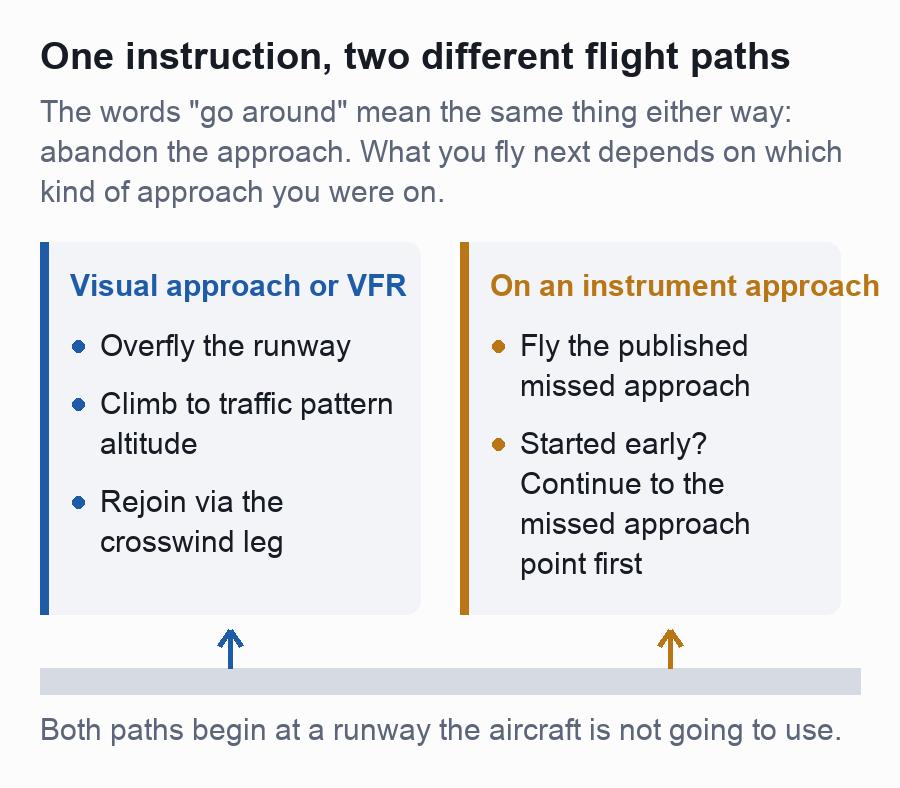
On a visual approach or under visual flight rules, the glossary is specific about the path: unless ATC says otherwise, the aircraft should overfly the runway while climbing to traffic pattern altitude, then rejoin the pattern on the crosswind leg. That is why the Airplane Flying Handbook describes the upwind leg as the part of the pattern flown after go-arounds. The aeroplane is simply going round again, which is where the phrase comes from.
On an instrument approach the ending is different. The same instruction sends the crew to the published missed approach procedure, and that procedure is printed on the approach chart with its own route and its own altitudes. The crew is not choosing where to go. They are flying something that was designed and surveyed long before they arrived.
Go-around or missed approach?
These two terms get used as synonyms and they are not quite the same thing. The difference is worth having straight, because it is the difference between an action and a procedure.
A go-around is the act of abandoning the landing, and it can happen on any approach, in any weather, at any point before the wheels are committed to the ground. A missed approach is narrower. The glossary defines it as a manoeuvre conducted when an instrument approach cannot be completed to a landing, with the route and the altitude shown on the chart. Every missed approach is a go-around. Not every go-around is a missed approach.
One detail inside that distinction catches people out. If a crew decides to abandon an instrument approach early, before the missed approach point, they do not turn away immediately. The glossary and the AIM both say they must continue along the final approach course to the missed approach point first, because the obstacle clearance that protects the procedure was surveyed around that path. The AIM is blunt about why: obstacle protection is predicated on the missed approach being started at the decision altitude or at the missed approach point, and not below the minimum descent altitude. Turning early puts the aircraft somewhere nobody checked.
Why pilots go around
The Airplane Flying Handbook lists the reasons plainly: air traffic control requirements, the unexpected appearance of a hazard on the runway, overtaking another aeroplane, wind shear, wake turbulence, mechanical failure, or an approach that has become unstable. Most of those have nothing to do with the pilot flying.
The handbook then says something that deserves to be read twice. The assumption that an aborted landing is always the consequence of a poor approach, and therefore of insufficient skill, is described as a fallacy. A go-around is what a working safety system looks like from the cabin window.
The AIM adds the formal version for instrument approaches. The pilot executes a missed approach on arrival at the missed approach point or decision height when visual reference to the runway environment is insufficient to land, or when a safe approach or landing is simply not possible, or when ATC instructs it. The pilot then tells ATC, including the reason unless ATC asked for it in the first place.

The button, the mode and the thrust
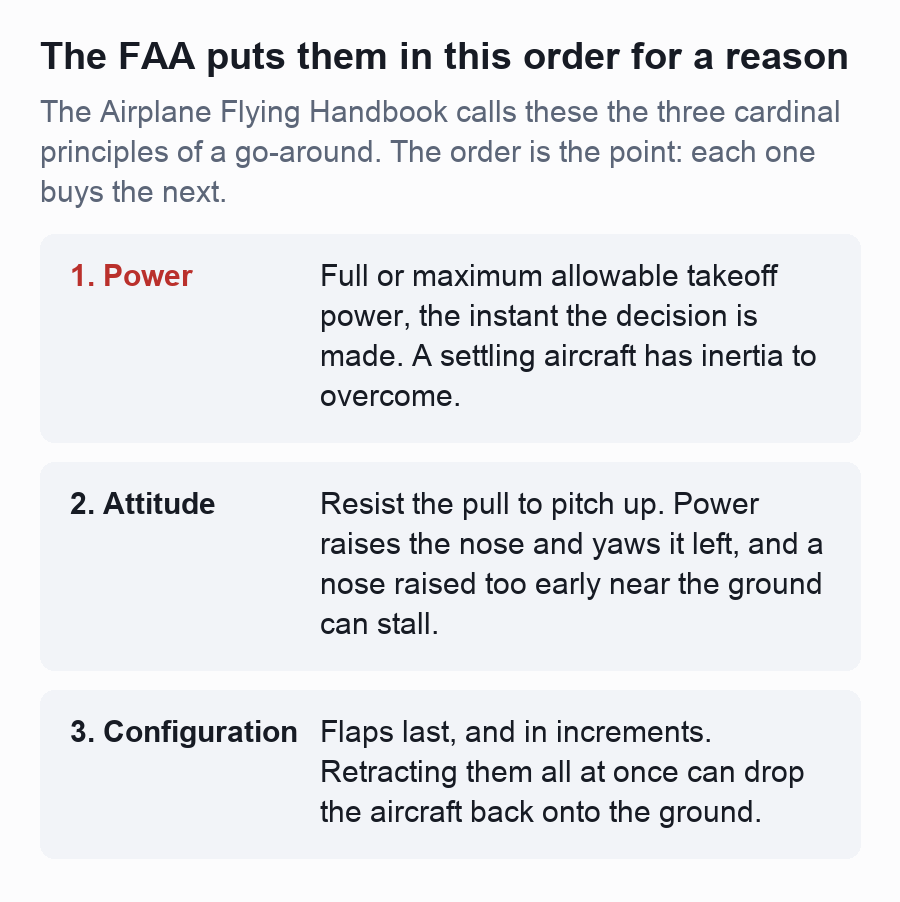
In a light aeroplane there is no button. The handbook reduces the whole manoeuvre to three cardinal principles in a fixed order: power, attitude, configuration. Power comes first because an aeroplane settling towards the ground has inertia to overcome and nothing else fixes that. Attitude comes second, and the warning attached to it is the one that kills people: the sudden application of power raises the nose and yaws the aircraft left, and allowing the nose to rise too early at low altitude can stall it. Configuration comes last, with the flaps retracted in increments rather than all at once, because dumping all the flap at once can drop the aeroplane back onto the runway it was trying to leave.
In an airliner there is a button, and the FAA’s Instrument Procedures Handbook glosses it in passing as TOGA, the take-off and go-around button used on some turbojets. Pressing it is the start of a sequence, not the whole of it. The handbook’s sample approach briefing has the pilot flying call for go-around thrust, flaps 15, positive climb, gear up, which is four separate actions after the button.
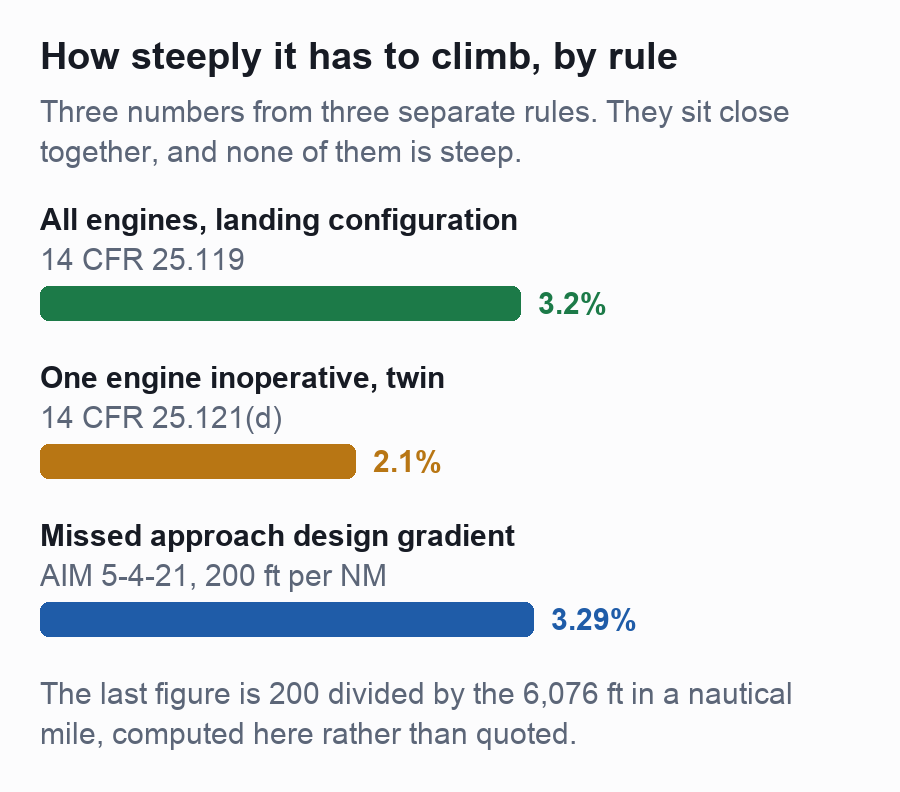
How much thrust, and how quickly, is a certification question with a surprisingly specific answer. Under 14 CFR 25.119 an airliner in the landing configuration must manage a steady climb gradient of at least 3.2 percent using the thrust that is available eight seconds after the levers are pushed from flight idle to the go-around setting. The rule builds in the spool-up time, because the engines do not answer instantly and the aeroplane is low when the question is asked.

There is a trap in the avionics too, and the AIM warns about it directly. Some GPS installations inhibit GPS navigation whenever any ILS frequency is tuned. On those aircraft a crew flying an ILS has to tune the ILS back to a VOR frequency before the GPS based missed approach will work at all, which is not a discovery anyone wants to make at the missed approach point.
How often it happens, and whether it is dangerous
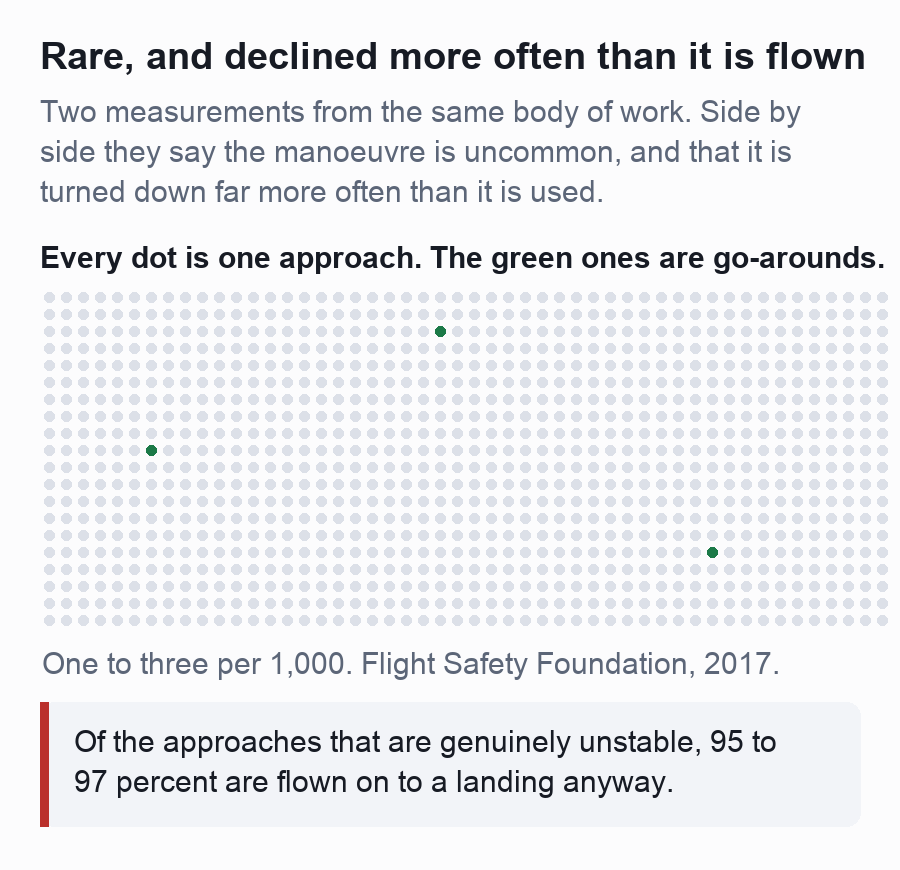
There is a real number for this. The Flight Safety Foundation’s Go-Around Decision-Making and Execution Project reports that go-arounds occur at an average rate of one to three per 1,000 approaches, with wide variation between operators and operating environments. On a runway handling 1,000 movements a day you might see one or two, and you might see none.
The second number from the same work is the uncomfortable one. Unstable approaches happen on 3.5 to 4.0 percent of all approaches, and 95 to 97 percent of those are flown on to a landing anyway. The manoeuvre is not just rare. It is declined far more often than it is used, by crews who have already met the condition their own airline wrote it for.

So is it dangerous? The handbook answers in one sentence: the go-around manoeuvre is not inherently dangerous in itself, and it becomes dangerous only when it is delayed unduly or executed improperly. The risk lives in the hesitation, not in the climb.
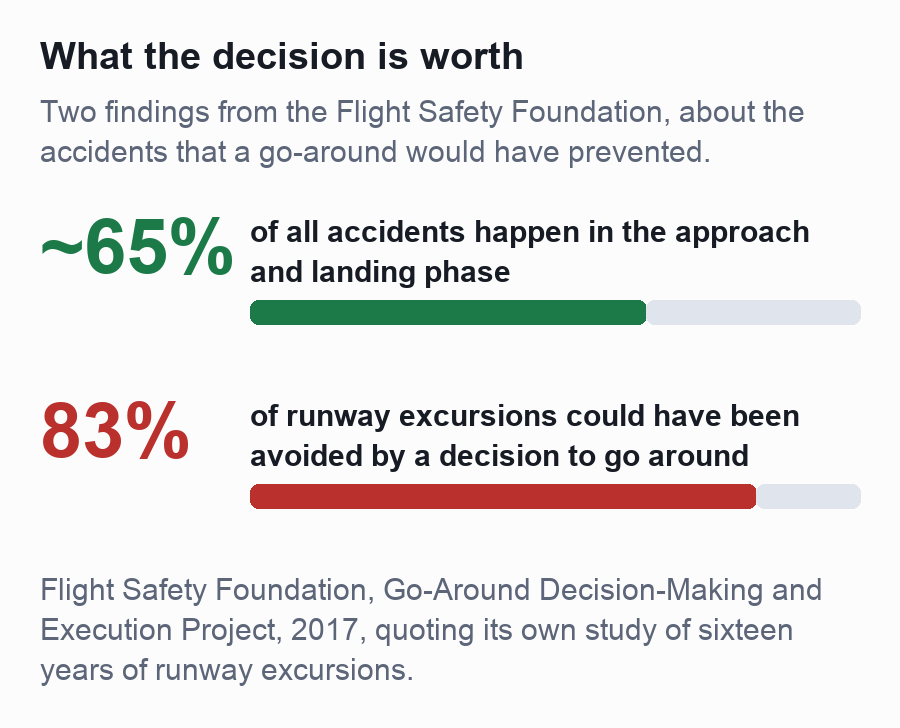
The handbook is unusually direct about where the hesitation comes from, and neither reason is technical. The first is landing expectancy, the anticipatory belief that conditions are not as threatening as they really are and that the approach is bound to end in a safe landing. The second is pride, described as the mistaken belief that going around is an admission of failure. The Flight Safety Foundation puts the cost of that in numbers: its study of sixteen years of runway excursions concluded that 83 percent of them could have been avoided by a decision to go around.

That is also why the go-around turns up in rules that have nothing to do with landing technique. Whether an airliner needs a fuel jettison system at all is decided by 14 CFR 25.1001, and the test is written as a fifteen minute flight made up of a takeoff, a go-around and a landing back at the airport it just left. If the aeroplane can climb away at maximum takeoff weight minus that much fuel, it never needs to dump fuel at all. The ability to go around is the measuring stick.
Common questions
What does the go-around button do? On aircraft that have one, the TOGA button commands go-around thrust and the associated flight director guidance. It is the first action in a sequence, not the whole manoeuvre: the published briefing still calls for flaps, a positive rate of climb and the gear.
How often do go-arounds happen at a big airport? At an average rate of one to three per 1,000 approaches, a busy runway sees a handful on a normal day and sometimes none. Rates vary widely between operators and airports.
Is a go-around an emergency? No. The FAA calls it a normal manoeuvre and the Flight Safety Foundation calls it a normal phase of flight. Crews practise it, and are expected to use it.
What is the difference between a go-around and a missed approach? A go-around is abandoning the landing. A missed approach is the published procedure flown when an instrument approach cannot be completed, with its route and altitudes printed on the chart.
Who decides, the pilot or the controller? Either. A controller can instruct a go-around, and a pilot can initiate one without being asked. When the pilot initiates it on an instrument approach, the AIM asks them to tell ATC and to include the reason.
Sources
- FAA Pilot/Controller Glossary, GO AROUND.
- FAA Pilot/Controller Glossary, MISSED APPROACH.
- FAA Aeronautical Information Manual 5-4-21, missed approach.
- FAA Aeronautical Information Manual 5-5-5, pilot and controller responsibilities.
- FAA Airplane Flying Handbook, chapter 9, go-arounds and rejected landings.
- 14 CFR 25.119, landing climb, all engines operating.
- 14 CFR 25.121(d), approach climb, one engine inoperative.
- 14 CFR 25.1001, fuel jettisoning system.
- Flight Safety Foundation, Go-Around Decision-Making and Execution Project, 2017.


