




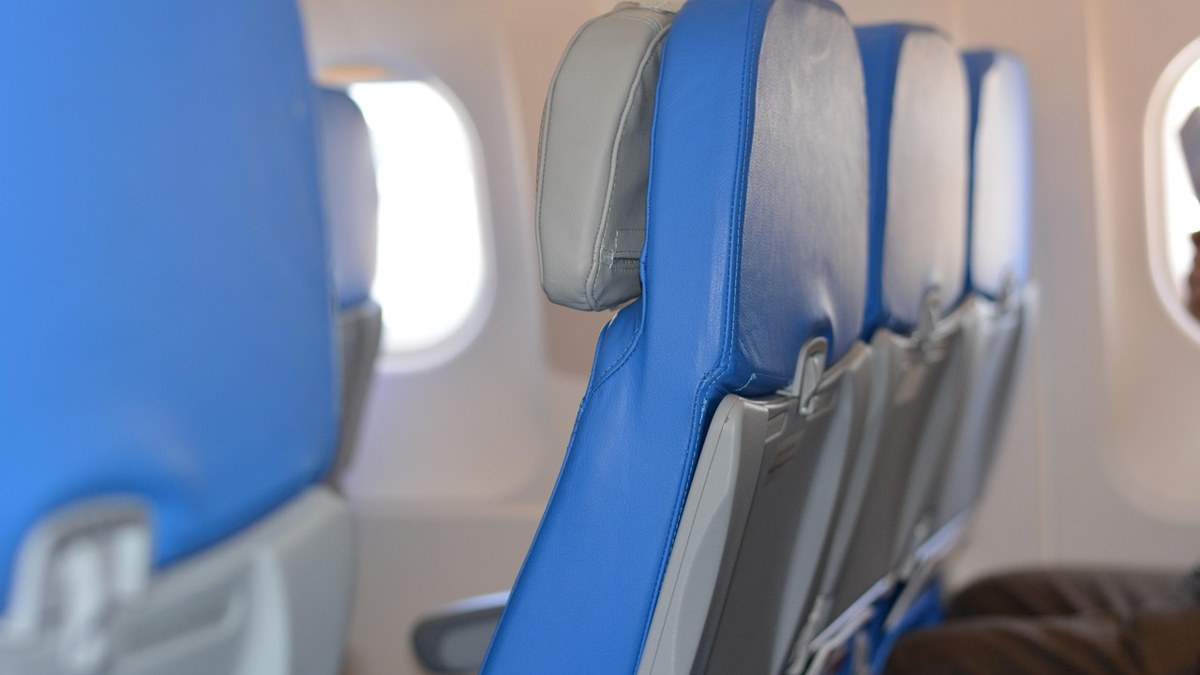
Ask a frequent flyer where they sit and you will get a firm opinion: aisle for the legroom, window for the view, front for the quick exit, never the back because of the noise. Ask them which seat is most likely to keep them alive in a crash and most will guess the front, or shrug and say it makes no difference. The crash data says both answers are wrong, and the seat that comes out on top is the one almost nobody chooses on purpose.
First, the number that matters most
Before we get to seat rows, the honest context: you are extraordinarily unlikely to need any of this. The International Air Transport Association’s 2024 safety report put the all-accident rate at roughly one per 880,000 flights, and fatal accidents at a small fraction of that. On that basis a person flying every single day would, on average, go thousands of years before being in a fatal accident. Aviation is not just safer than driving per mile; it is safer than almost anything else you do.
The second number is just as surprising. When the US National Transportation Safety Board looked at every serious commercial accident in the United States between 1983 and 2000, more than 95 percent of the people on board survived. Even in accidents that were serious enough to involve fire, structural break-up or fatalities, the majority of passengers walked away. Crashes are not the all-or-nothing events films make them look like, and that is exactly why where you sit, and what you do, can matter.
What the seating data actually shows
The most quoted analysis comes from TIME magazine, which in 2015 went through the Federal Aviation Administration’s accident database and pulled out every crash since 1985 that had both fatalities and survivors, with seat-by-seat records of who was where. Across those accidents:
- Seats in the rear third of the aircraft had a 32 percent fatality rate.
- Seats in the middle third had a 39 percent fatality rate.
- Seats in the front third had a 38 percent fatality rate.
Break it down further and the pattern sharpens. The middle seats in the rear of the cabin, the seat everyone avoids, had the lowest fatality rate of all at 28 percent. The worst place to be was an aisle seat in the middle third of the aircraft, at 44 percent.
An earlier and separate analysis by Popular Mechanics in 2007, covering US crashes since 1971, reached the same conclusion from a different direction: passengers seated behind the wing had a survival rate of about 69 percent, compared with 56 percent over the wing and 49 percent in the front of the cabin.
Then there is the one time somebody deliberately crashed an airliner to find out. In 2012 a television production bought a Boeing 727, fitted it with crash-test dummies and sensors, and flew it by remote control into the Mexican desert. The nose and the first eleven rows were destroyed; a dummy in row 7 recorded forces no human survives. Further back, the forces dropped to survivable levels, and the dummies at the rear would in all likelihood have walked away.
Why the back does better
Most survivable accidents are not mid-air events. They happen on or near the ground: a runway overrun, a hard landing, a collapsed undercarriage, an aborted take-off that ends in the grass. In almost all of those the aircraft is moving forward when it hits something, so the nose takes the first and heaviest impact and the front of the fuselage absorbs energy that the rear never sees. The tail section is also, structurally, one of the strongest parts of the airframe, which is why it is so often the piece found intact in wreckage photos.
There is a second, less obvious reason. Fire, not impact, is what kills most people in accidents that are survivable at all, and fuel is carried in the wings and the centre section. Seats well behind the wing are farther from where a fire tends to start.
The caveats, because there are real ones
Every one of these studies comes with the same warning from its authors: the data is small, the accidents are all different, and the result depends heavily on what kind of accident you are in. A tail-first impact reverses the picture. The FAA itself has stated there is no single safest seat. And when researchers at the University of Greenwich in London interviewed more than 2,000 survivors of 105 accidents, they found that the row number mattered far less than something else entirely.
The factor that matters more than the row: the exit
The Greenwich team, led by Professor Ed Galea, found that passengers who survived were overwhelmingly seated within five rows of a usable emergency exit. Beyond five rows the odds of getting out fell sharply. Aisle seats did slightly better than window seats in that study because an aisle passenger does not have to wait for anyone else to move, and passengers who had actually read the safety card and counted the rows to their nearest exit got out faster than those who had not.
That reframes the whole question. The rear of the cabin has the best impact statistics, but a rear seat six or seven rows from the nearest door in a fire is a worse place to be than a mid-cabin seat right next to an overwing exit. The seat to look for, if you want to stack the odds, is one within a few rows of an exit, ideally an aisle, and ideally toward the back.
The 90-second rule and why it should change how you board
Every airliner must be certified to evacuate a full cabin through half its exits in 90 seconds, in the dark, with untrained passengers. That figure is not arbitrary. In a fuel-fed fire, flashover, the moment the cabin air itself ignites, can occur roughly a minute and a half after the fire starts. Cabin crew are trained to empty an aircraft in that window and they are ruthless about it, which is why they shout, why they will physically pull people through the door, and why the safety briefing tells you, every single time, to leave your bags behind.
Watch the video of any real evacuation and you will see passengers dragging roll-aboard cases down the aisle. Every one of those bags is seconds subtracted from the 90, for everyone behind it.
What a frequent flyer actually does with this
- Pick a seat within five rows of an exit when you have a choice, and count the rows when you sit down. In smoke you will be doing this by touch.
- Prefer the rear of the cabin if the exit distance is similar. The back is noisier and the last off, but the numbers favour it.
- Aisle over window if getting out fast is the priority. Window seats near an overwing exit are the exception.
- Keep your shoes on and your seatbelt fastened, low and tight, for the first few minutes and the last few minutes. That is when most accidents happen, and a loose belt is how people get hurt in an event that would otherwise leave everyone unscathed.
- Know the brace position. It is not a symbolic gesture; it is designed to stop your head and limbs hitting the seat in front with enough force to knock you out, which is what stops people evacuating.
- Leave everything. Bags, laptops, jackets. Everything.
None of this is a reason to worry. It is the opposite: the record shows that most people in most accidents survive, and that a few seconds of attention when you sit down tilts the odds further in your favour. If you want the rest of the cabin’s hidden logic, read what the chimes on a plane actually mean, including why the lights go dim for landing, and what is happening on the flight deck while you are choosing your seat.
Frequently asked questions
Is the back of the plane really the safest place to sit?
Historically, yes. Analyses of FAA accident data found the rear third of the cabin had the lowest fatality rate (around 32 percent in accidents with both fatalities and survivors, versus 38 to 39 percent further forward), and the rear middle seats did best of all. Results vary by accident type, and proximity to an exit matters at least as much.
Are aisle or window seats safer?
For evacuation, aisle seats have a slight edge because you can move immediately. For impact, the rear middle seats performed best in the TIME analysis. Being within five rows of an exit outweighs either.
Is first class safer than economy?
No. First class sits at the front, which takes the heaviest impact in most survivable accidents. The advantage of the front is a short walk to a door, not survivability.
What are the odds of dying in a plane crash?
Vanishingly small. Industry data puts fatal accidents at well under one per million flights, and more than 95 percent of passengers in serious US accidents between 1983 and 2000 survived.
Sources: TIME analysis of FAA CSRTG accident data (2015); Popular Mechanics accident review (2007); NTSB survivability study 1983–2000; University of Greenwich evacuation research (Prof. Ed Galea) for the UK CAA; IATA Safety Report 2024; FAA 90-second evacuation certification standard (14 CFR 25.803).