


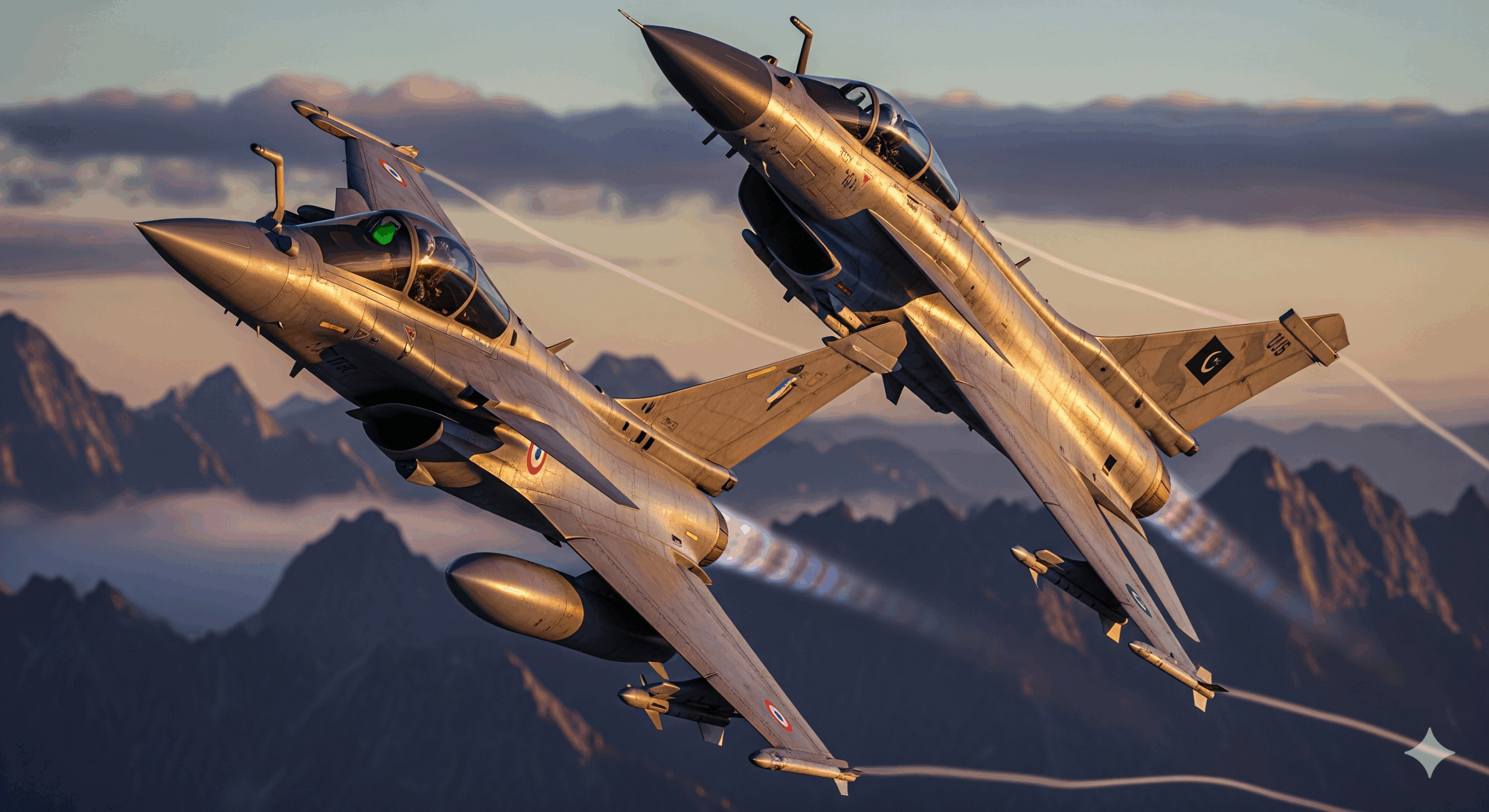
Title: J-10C vs Rafale: A Classic Aerial Clash Between Pakistan and India
Disclaimer: This article explores a hypothetical classic aerial engagement between Pakistan’s J-10C and India’s Rafale fighter jets. It analyses their specifications, strategic doctrines, past usage, and implications in a South Asian conflict scenario.
Introduction
Air superiority remains central to modern warfare, especially in regions marked by long-standing tensions like South Asia. In recent years, both Pakistan and India have made significant upgrades to their air forces. Pakistan’s induction of the Chinese-made J-10C and India’s acquisition of the French Dassault Rafale have introduced two potent 4.5 generation fighters into the subcontinent.
While no direct air battle between these two aircraft has occurred to date, military analysts, enthusiasts, and regional strategists frequently speculate about a possible encounter. This article offers a detailed examination of how a theoretical clash might play out, based on available performance data, pilot training regimes, doctrine, and recent regional skirmishes.

Section 1: Aircraft Background
Pakistan J-10C ‘Vigorous Dragon’
- Origin: China (Chengdu Aerospace Corporation)
- Entered Service with PAF: 2022
- Role: Multirole fighter
- Notable Systems: AESA radar, PL-15 and PL-10 missile systems
- Radar Cross Section: Estimated between 1-3 m²
- Strengths:
- Excellent BVR missile (PL-15)
- Modern electronic warfare and datalink systems
- High agility due to relaxed static stability and digital FBW
The J-10C represents the most advanced fighter in PAF service after the older F-16 Block 52s. It is heavily optimised for beyond visual range (BVR) engagements, with the PL-15 missile boasting an estimated range of 200-300 km.
Indian Rafale
- Origin: France (Dassault Aviation)
- Entered Service with IAF: 2020
- Role: Omnirole fighter
- Notable Systems: RBE2 AESA radar, SPECTRA EW suite, Meteor missile
- Radar Cross Section: Roughly 0.1 m² (with limited stealth features)
- Strengths:
- Excellent situational awareness
- Powerful ECM via SPECTRA
- High-speed long-range Meteor missile (150+ km)
The Rafale has been the centrepiece of IAF modernisation, offering excellent survivability, avionics, and weapons. It is well-suited for multirole operations from high-altitude air bases in Ladakh and the western sector.
Section 2: Technical Comparison
| Feature | J-10C (PAF) | Rafale (IAF) |
|---|---|---|
| Engine | WS-10B | Snecma M88-2 |
| Max Speed | Mach 1.8 | Mach 1.8 |
| Radar | KLJ-7A AESA | RBE2 AA AESA |
| Avionics | Chinese indigenous systems | French-integrated systems with Thales sensors |
| BVR Missile | PL-15 (~250 km) | Meteor (~150-200 km) |
| WVR Missile | PL-10 | MICA IR |
| Combat Radius | ~1,200 km | ~1,850 km |
| Thrust-to-weight ratio | ~1.13 | ~1.10 |
| ECM | Moderate | Advanced (SPECTRA) |
Section 3: Hypothetical Engagement Scenario
Context: A conflict erupts near the Line of Control. Both sides scramble CAP (Combat Air Patrol) units. Three Rafales and two J-10Cs are vectored for interception.
Phase 1: Detection
- Rafale’s SPECTRA suite picks up radar emissions early.
- J-10C’s AESA radar detects targets at longer range (~160+ km).
- J-10Cs get targeting data from support aircraft, giving them first-launch advantage.
Phase 2: BVR Exchange
- Pakistan launches PL-15 missiles at extended ranges, targeting all three Rafales.
- PL-15’s active radar guidance and high speed overwhelm Rafale defences.
- Despite SPECTRA’s jamming, two Rafales are downed in quick succession due to simultaneous saturation strikes.
- Third Rafale attempts escape manoeuvre but is pursued and shot down shortly after.
Result: All three Indian Rafales are confirmed kills. No damage sustained by J-10Cs.
Phase 3: Aftermath
- Indian ground radar and AWACS confirm losses. No PAF aircraft breached.
- Engagement duration estimated under 12 minutes.
Outcome: Clear victory for PAF J-10Cs, showcasing PL-15 missile dominance and effective electronic coordination.
Section 4: Pilot Training and Doctrine
Pakistan Air Force (PAF)
- Focus on BVR dominance and flexible force deployment.
- Has joint exercises with China (Shaheen series).
- Operates in conjunction with F-16s, early warning systems.
Indian Air Force (IAF)
- More budget, more multirole missions, regular Red Flag and Garuda participation.
- Integrated command network and satellite support.
- High pilot flying hours and diverse aircraft experience.
Section 5: Strategic Implications
- Balance of Power: The encounter shifts perception of air superiority in South Asia. PL-15’s performance outmatched Meteor.
- Defence Procurement: India may fast-track indigenous AMCA and consider adding more EW and AWACS layers. Pakistan’s J-10C is now a centrepiece.
- Chinese Influence: Clear operational proof of PLAAF-exported systems dominating Western tech boosts Chinese exports globally.
- Western Alignment: Rafale’s loss prompts reevaluation of its cost-to-capability ratio in dense EW environments.
Section 6: Historical Context
- Kargil 1999: Air power played a limited role but highlighted high-altitude operations.
- Balakot 2019: India struck Pakistan; PAF responded with a dogfight that downed an IAF MiG-21.
- Current Posture: Both countries have overlapping AD zones. Rafales are stationed at Ambala and Hasimara. J-10Cs are deployed at Kamra and Jacobabad.
Section 7: International Reactions
- China: Uses success to market J-10C and PL-15 globally.
- France: Faces scrutiny over Rafale’s real-world survivability.
- US and Russia: Monitor for rebalancing – could propose enhanced support or new platforms to both sides.
Section 8: Public Sentiment and Media Coverage
- Pakistan: Media hails it as a defining air combat success.
- India: Internal debate over Rafale programme’s ROI.
- Neutral Analysts: Note that even advanced aircraft are vulnerable if EW and BVR support are lacking.
Conclusion
This hypothetical clash delivers a decisive win for the Pakistan Air Force. The J-10C’s advanced radar, long-range PL-15 missiles, and coordination with support systems proved superior against the Rafale’s defences. The key difference lay not just in aircraft capability but in the broader electronic warfare environment and missile engagement ranges.
The result underscores a shift in regional air power dynamics, with Pakistan’s adoption of Chinese systems demonstrating that cost-effective platforms can outmatch more expensive Western designs in the right tactical setting.
