


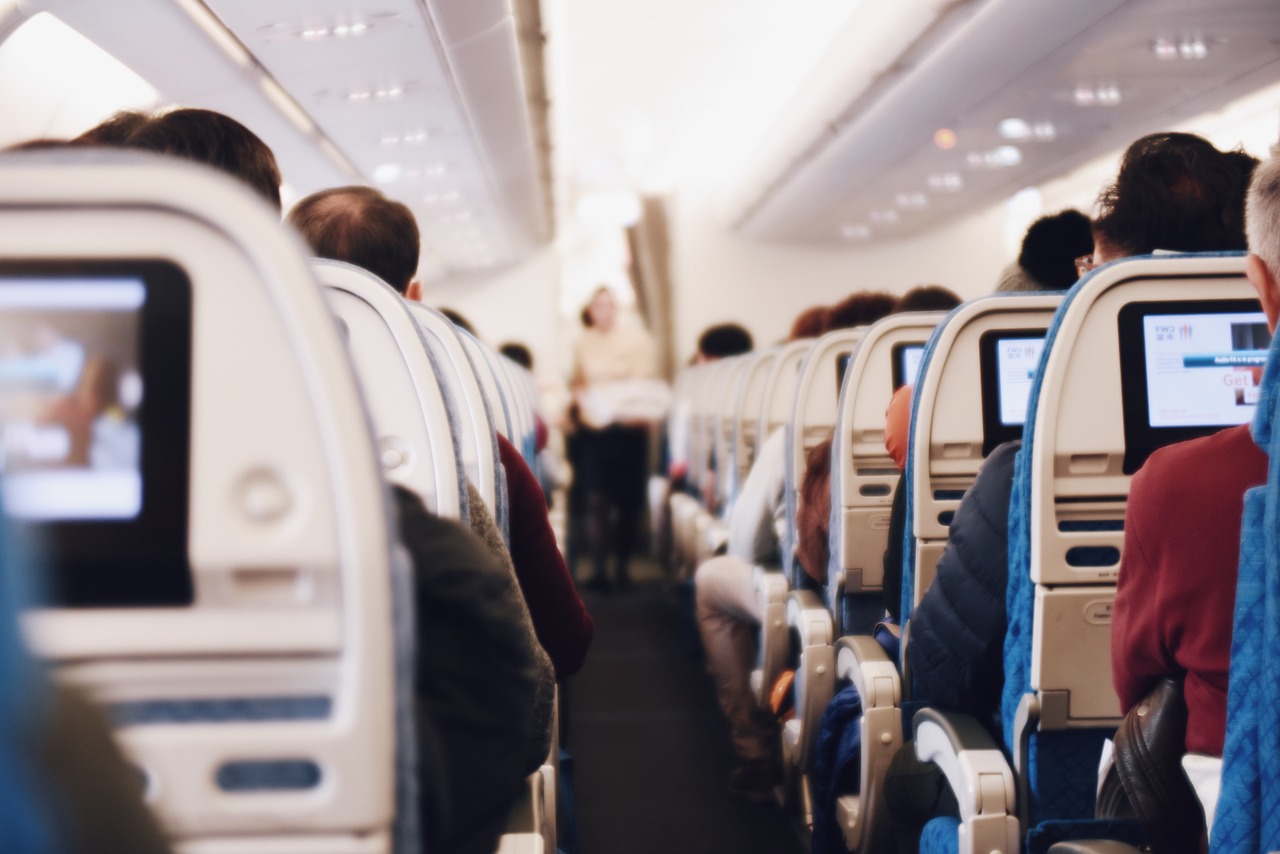
The cabin crew come through, the trolleys disappear, and then the lights drop to almost nothing. If it is a night flight you are suddenly sitting in near darkness with a thin strip of blue glowing along the floor. Most people assume it is a courtesy, something to help the cabin settle down and sleep, or a way of saving a little power while the engines are working hardest.
It is neither. The dimming belongs to the same family as three other instructions you get in the last few minutes before takeoff and the last few minutes before landing: seat back upright, tray table stowed, bag under the seat or in the bin. People tend to file all four under airline fussiness. They are not fussiness, and two of the four are not even requests. They are federal law.
All of it points at one number, and the number is not in the cabin announcement.
The ninety seconds that explain the whole routine
Before an airliner with more than 44 passenger seats can be sold to anybody, the manufacturer has to prove something awkward. Title 14 of the Code of Federal Regulations, section 25.803, requires that it “must be shown that the maximum seating capacity, including the number of crewmembers required by the operating rules for which certification is requested, can be evacuated from the airplane to the ground under simulated emergency conditions within 90 seconds”.
Ninety seconds. Every seat full, the crew on board, everybody on the ground. Not to the door, not onto the wing, all the way to the ground.
That number is why the cabin looks the way it does in the last moments of a flight. It is not a target anybody expects to hit on a normal day. It is the figure the aircraft was certified against, and the cabin procedures exist to keep the real thing as close as possible to the test.
What the certification test actually looks like
The conditions are set out in Appendix J to part 25, and they are stricter than most people imagine. Reading them is what makes the cabin routine click into place.
The demonstration happens in the dark. The rule puts a number on the darkness: exterior ambient light “no greater than 0.3 foot-candles” before the aircraft’s emergency lighting comes on. Once it starts, “only the airplane’s emergency lighting system may provide illumination”. No floodlights, no hangar lighting, nothing helpful.
The cabin is deliberately untidy. Before the start, “approximately one-half of the total average amount of carry-on baggage, blankets, pillows, and other similar articles must be distributed at several locations in aisles and emergency exit access ways to create minor obstructions”. The regulation wants the clutter in the way.
The people are not stunt performers. The passenger load has to be at least 40 percent female, at least 35 percent over 50 years of age, and at least 15 percent both female and over 50. Three life-size dolls ride along to stand in for infants under two. Employees of the applicant cannot be seated next to an emergency exit, and nobody who has taken part in a demonstration like it within the previous six months can take part again.
Nobody gets a hint. There may be no prior indication of which exits will be used, the aircraft has to be configured so the active exits are not given away, and the applicant may not “practice, rehearse, or describe the demonstration” to the people taking part.
And here is the detail that is almost always described wrongly. You will often read that the test is run with half the exits blocked. What Appendix J actually says is that the exits used “must consist of one exit from each exit pair”, chosen by the manufacturer with the regulator’s approval, representative of all the exit types on the aircraft, including at least one at floor level. One of each pair is a more specific thing than half at random, and it is the reason cabin crew care so much about which door you are sitting beside.
Doors and curtains in the takeoff configuration. Belts and harnesses fastened. The clock stops only when the last person is on the ground.
Dimming the cabin is about your eyes, not the light bulb
Now put yourself in that test. The lighting is down to the emergency system, and the cabin you have to cross is lit like a cinema just after the film starts. If your eyes have spent the last hour adjusted to full cabin lighting, you cannot see any of it.
The FAA explains the mechanism in its own training material, writing about pilots rather than passengers. Its Introduction to Aviation Physiology describes the rods, the receptors you see with in low light, and the substance they depend on: rhodopsin, or visual purple, “which bleaches very rapidly when exposed to bright light, but the regeneration of this substance can take between 30 to 60 minutes of dark adaptation”.
Half an hour to an hour to recover properly. That is the figure that matters, because an evacuation does not give you thirty seconds, let alone thirty minutes.
The same documents show the practice that follows from it. The FAA’s night operations guidance tells pilots to keep cockpit lighting low to see outside detail better, calls the habit light discipline, and even asks pilots to brief their passengers about it so that a cabin light does not cost the flight deck its night adaptation. One of its figures is captioned, plainly, as the effects of dimming cockpit lighting during night flight to better see surroundings.
Dimming the cabin applies that same mechanism to everybody on board. Your eyes get a head start on the dark, during the two windows when an evacuation is most likely. It also means that if the lighting fails, the change is small rather than total, and the floor track and exit signs are already the brightest things you can see.
One honest limit on all of this. The FAA writes the dark adaptation guidance for flight crews, not for the cabin. The physiology is the physiology, and the airlines apply it to the passenger compartment, but anybody telling you the FAA requires your reading light to go off is overstating it. Which brings us to the part that surprises people.
Four cabin rules, and only some of them are law
These instructions arrive in the same tone of voice, so they sound like one rulebook. They are not. Here is where each one actually comes from in the United States.
| What you are asked to do | Federal rule? | Where it comes from |
|---|---|---|
| Seat back in the upright position | Yes | 14 CFR 121.311(e). No operator may take off or land “unless each passenger seat back is in the upright position” |
| Tray table stowed | Yes | 14 CFR 121.577(b), which covers each “food and beverage tray and seat back tray table” |
| Bags stowed | Yes | 14 CFR 121.589(c). A crewmember also has to verify it before the doors close |
| Seat belt sign on | Yes | 14 CFR 121.317(b), for every takeoff and every landing |
| Cabin lights dimmed | No | Airline procedure, resting on the dark adaptation physiology above |
| Window shades up | No | Airline procedure, and not a uniform one |
Those first four sit in the operating rules, and two of them say in as many words that passengers have to comply with crew instructions on the point. The last two are procedure. That is not a reason to ignore them, and it does explain something you may have noticed: the lighting and shade instructions vary between airlines and between countries, while the upright seat does not.
So why do the shades have to be up?
Because the shade is the only instrument in the cabin pointing outwards.
With the shades up, the cabin crew can see which side the damage is on, whether there is fire near a wing, whether the ground on their side is where it should be, and whether a door they are about to open leads somewhere survivable. Emergency services outside can see in. And your eyes get the same benefit the dimming gives them, because at night an open shade is part of the same darkness your vision is adapting to, while in daylight it keeps the cabin lit if the electrical system has stopped.
None of that is in part 121, which is why a crew on one airline will insist on it and a crew on another will not mention it. It is a procedure built on the same ninety seconds.
What to actually do with this
Very little, and that is the point. Put the seat up, stow the table, push the bag properly under the seat in front rather than wedging it half out, and leave the shade where the crew asked.
The one thing worth changing is where you look. In the minute after the lights go down, find your nearest exit and count the rows to it. In the dark, with the clutter the regulation deliberately puts in the aisle, a number you already know is worth more than a sign you are hoping to read.
If you want the other half of the lighting story, the lights on the outside of the aircraft follow a completely different set of rules, and we covered what the red, green and white lights on a plane mean separately. The cabin temperature you are probably also wondering about has its own explanation, and if the approach you are on gets abandoned at the last second, that is a go around and it is routine.
Sources, all read for this piece: 14 CFR 25.803 and Appendix J to part 25, Emergency Evacuation, via the Electronic Code of Federal Regulations as in force 24 November 2026; 14 CFR 121.311, 121.317, 121.577 and 121.589; the FAA’s Introduction to Aviation Physiology on rods, rhodopsin and dark adaptation; and the FAA’s Night Operations guidance, chapter 13, on light discipline and cockpit dimming.
