


Choosing between the Phenom 300, Citation Excel, and Challenger 350 isn’t simple. Each aircraft dominates different segments of the private jet market. The Phenom 300 leads light jet sales globally. The Citation Excel offers proven midsize reliability. The Challenger 350 delivers super-midsize performance.
This comparison cuts through marketing claims. You’ll see real specifications, operating costs, and mission profiles. By the end, you’ll know which jet fits your needs.
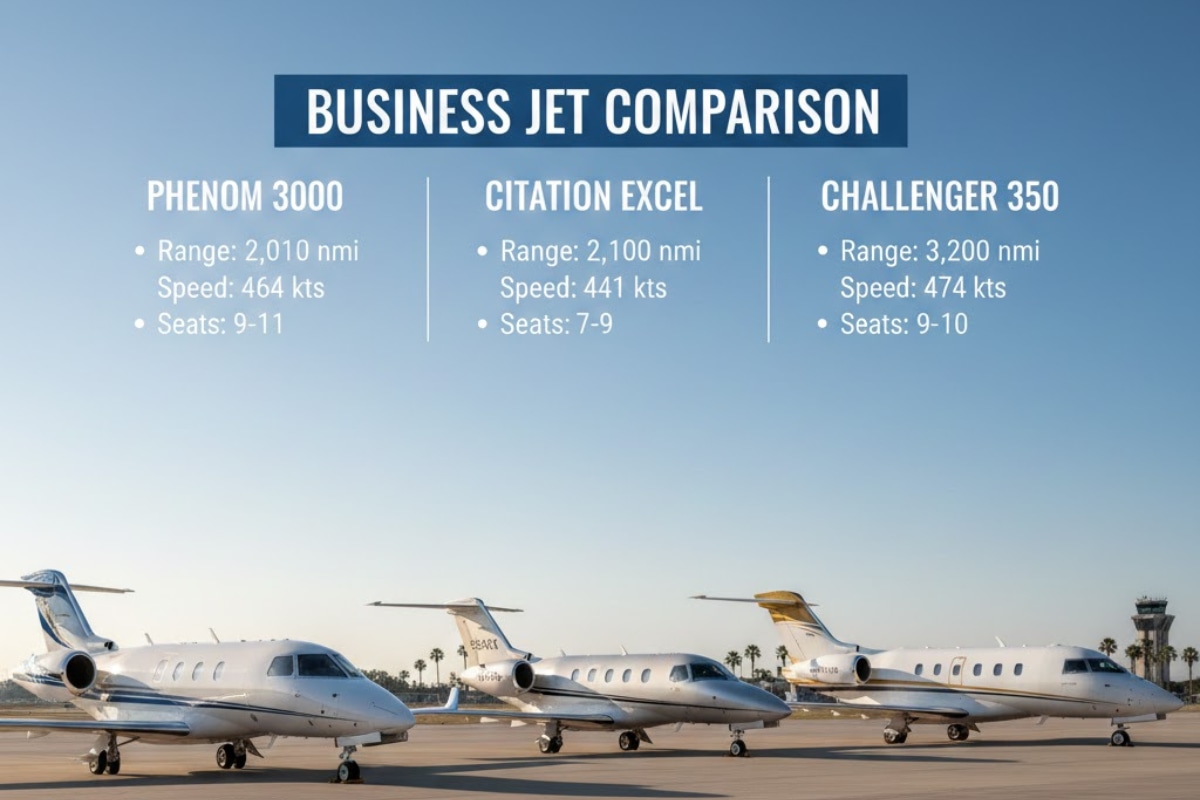
Quick Specifications At A Glance
Here’s how these three aircraft stack up:
Phenom 300E (Light Jet)
- Range: 2,010 nautical miles
- Speed: 464 knots (Mach 0.80)
- Passengers: 7-9
- Price: $11 million (2025)
Citation Excel/XLS+ (Midsize Jet)
- Range: 1,720-2,100 nautical miles
- Speed: 441 knots (Mach 0.75)
- Passengers: 7-8
- Price: $16.1 million (2023)
Challenger 350 (Super-Midsize Jet)
- Range: 3,200 nautical miles
- Speed: 470 knots (Mach 0.83)
- Passengers: 8-10
- Price: $27 million (2024)
These aren’t just numbers. They define what missions each aircraft can handle.
Performance: Where Each Aircraft Excels
The Challenger 350 outperforms both competitors in pure range. Flying 3,200 nautical miles means true coast-to-coast capability. New York to Los Angeles? No problem. The aircraft handles transcontinental routes without refueling.
The Phenom 300 surprises many buyers. Despite being classified as a light jet, it flies 2,010 nautical miles. That beats the Citation Excel’s range. Houston to Seattle becomes possible. Denver to Miami works easily.
The Citation Excel sits in the middle at approximately 1,850 nautical miles. Regional travel is its sweet spot. Think New York to Miami or Dallas to Los Angeles.
Speed differences matter less than you’d think. The Challenger 350 cruises at Mach 0.83. The Phenom 300 hits Mach 0.80. The Citation Excel reaches Mach 0.75. On a typical 1,000-mile flight, you save maybe 15 minutes choosing the fastest option.
Takeoff performance tells another story. The Citation Excel needs just 3,500 feet of runway. The Phenom 300 requires 3,209 feet. The Challenger 350 demands 4,835 feet. Smaller airports favor the lighter jets.
All three aircraft cruise at 45,000 feet. They fly above most weather and commercial traffic. This creates smooth, efficient flights.
Cabin Experience: Size and Comfort
The Challenger 350 offers the widest cabin in this comparison. At 7.2 feet wide and 6.1 feet tall, passengers move freely. The flat floor spans 28.6 feet. Ten passengers fit comfortably in a typical configuration.
Baggage capacity reaches 106 cubic feet. That’s enough for golf clubs, skis, and extensive luggage. Access to the baggage compartment happens in-flight. Passengers don’t wait until landing to retrieve items.
The Citation Excel provides a stand-up cabin at 5.7 feet high. Width measures 5.5 feet. The cabin length extends 18.7 feet. Eight passengers fit the standard layout. Baggage space totals 80-90 cubic feet externally.
The Phenom 300 cabin surprises for a light jet. Height reaches 4.9 feet. Width spans 5.1 feet. Length measures 17.2 feet. Seven to nine passengers fit depending on configuration. Baggage capacity hits 84 cubic feet total.
Noise levels differ significantly. The Challenger 350 features superior sound insulation. Corporate conversations happen naturally. The Citation Excel offers triple-sealed doors and triple-pane windows. The Phenom 300 remains quieter than most light jets.
Window size creates different experiences. The Challenger 350’s windows are 20% larger than the previous model. The Phenom 300 features oversized windows for its class. The Citation Excel uses standard-sized windows.
Operating Economics: The Real Cost Picture
Operating costs separate these aircraft dramatically. The Phenom 300 costs approximately $1,758-$2,200 per flight hour. That’s the most economical option here.
The Citation Excel runs $2,000-$2,400 hourly. Slightly higher than the Phenom 300 but still reasonable for the category.
The Challenger 350 demands $3,152 per hour. That’s 50% more than the Citation Excel. The larger cabin and longer range drive up fuel burn.
Fuel efficiency favors the Phenom 300. Embraer claims it burns 19% less fuel than competitors. The advanced PW535E1 engines deliver this efficiency. Lower fuel costs matter over hundreds of flight hours annually.
Maintenance networks differ by manufacturer. Cessna operates the largest service network globally. Parts availability exceeds competitors. Embraer built a strong support system over the past decade. Bombardier maintains excellent service centers but fewer locations.
Resale values tell an important story. The Phenom 300 held strong market position for over 10 years. Five-year-old models retain approximately 60% of original value. The Citation XLS shows similar retention. The Challenger 350 maintains excellent residuals due to strong demand.
Mission Profiles: Best Use Cases
Choose the Phenom 300 if you:
- Fly primarily regional routes (under 1,800 miles)
- Need access to smaller airports
- Want lowest operating costs
- Operate with smaller passenger groups (4-6 people typically)
- Value fuel efficiency and modern safety features
Example routes: New York to Palm Beach, Houston to Aspen, San Francisco to Scottsdale.
Choose the Citation Excel if you:
- Require proven reliability over latest features
- Operate regional and some transcontinental routes
- Need extensive service network access
- Prefer midsize cabin comfort
- Value short-field performance
Example routes: Teterboro to Naples, Van Nuys to Cabo, Chicago to Miami.
Choose the Challenger 350 if you:
- Fly transcontinental or international routes regularly
- Need true coast-to-coast range
- Carry larger passenger groups (7-10 people)
- Require maximum cabin space and comfort
- Don’t prioritize operating cost efficiency
Example routes: New York to Los Angeles, London to New York, Paris to Dubai.
The Decision Framework
Your mission profile drives the right choice. Calculate your typical routes. Count average passengers. Factor in annual flight hours.
For under 200 hours yearly with regional flights, the Phenom 300 delivers best value. Operating cost savings add up significantly.
For 200-400 hours with mixed regional and transcontinental flights, the Citation Excel or XLS+ offers balance. Proven reliability reduces downtime.
For 400+ hours with transcontinental requirements, the Challenger 350 justifies higher costs. The cabin space and range become essential.
The Phenom 300 wins on efficiency and modern features. The Citation Excel wins on versatility and service network. The Challenger 350 wins on capability and comfort.
For more information, visit Crew Daily.
