




If your flights have felt bumpier lately, it is not just you, and it is not your imagination. A growing body of climate research now shows that turbulence is genuinely getting worse, and the mechanism behind it is well understood: a warming atmosphere is reshaping the jet streams that aircraft fly through every day. Here is what the actual data says, and what it means for how you fly.

The Data Behind the Bumpy Flights
Two separate research efforts, both led out of the University of Reading, have put real numbers on what pilots have been reporting anecdotally for years. The first, published in the Journal of Geophysical Research: Atmospheres and led by researcher Mohamed Foudad, reconstructed four decades of atmospheric data from 1980 to 2021. It found that moderate-to-severe clear-air turbulence increased by 60% to 155% across North Africa, East Asia, the Middle East, the North Atlantic, and the North Pacific over that period.
East Asia already has it worst: aircraft flying through the region now encounter clear-air turbulence roughly 7.5% of the time, by far the highest rate of any region studied, compared with about 1% of flight time across the Northern Hemisphere overall.
A second study out of the University of Reading, led by PhD researcher Joana Medeiros alongside Professor Paul Williams, modeled what happens next. Running 26 global climate models forward to the year 2100, the team projected wind shear at cruising altitude increasing by 16% to 27%, while atmospheric stability drops by 10% to 20%. Both changes independently make clear-air turbulence more likely, and together they compound.
Why a Warmer Atmosphere Means Rougher Air
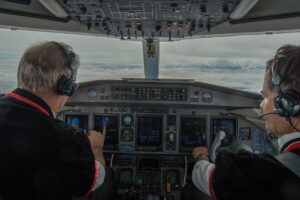
Clear-air turbulence forms when air masses moving at different speeds collide, most often at the edges of the jet stream near typical cruising altitudes around 35,000 feet. It has no clouds, no radar signature, and no visual warning, which is exactly why it catches passengers and unbuckled crew off guard, and it’s one of several things happening up front that passengers rarely think about; our look at what really happens in the cockpit covers the rest.
Climate change intensifies the temperature difference between the equator and the poles at jet-stream altitude, and that temperature gradient is what drives wind shear. As Joana Medeiros put it, “Increased wind shear and reduced stability work together to create favourable conditions for clear-air turbulence, the invisible, sudden jolts that cannot be seen on radar.” The warmer the atmosphere gets, the sharper those gradients become, and the more often aircraft cross through them.

What This Costs the Industry
Turbulence is not just uncomfortable, it is expensive. Turbulence-related delays, diversions, injuries, and aircraft inspections already cost U.S. airlines an estimated $150 million to $500 million every year, and that figure is based on current conditions, not the rougher skies the models project for later this century. Clear-air turbulence specifically is responsible for the majority of weather-related aviation accidents, since it cannot be detected by onboard weather radar the way thunderstorms can.
Airlines are not standing still. Professor Williams noted that “pilots may need to keep seatbelt signs on longer and suspend cabin service more often during flights, but airlines will also need new technology to spot turbulence before it hits.” Several carriers have already expanded real-time turbulence reporting between aircraft in the same airspace, feeding pilot reports into shared systems faster than traditional forecasting allows, a shift that overlaps with the broader airspace modernization we covered in our FAA NextGen guide.
What This Means for How You Fly
- Keep your seatbelt on when seated. Since clear-air turbulence gives no visual warning, the seatbelt sign is the only defense most passengers have, and it is worth treating “seated” as “buckled” by default rather than only during forecast rough air.
- Expect longer seatbelt-sign periods on transatlantic and transpacific routes. The North Atlantic and North Pacific are two of the regions with the sharpest documented increases, and both carry heavy volumes of long-haul traffic.
- Turbulence forecasts are becoming more sophisticated, not less reliable. The same research pushing these numbers into public view is also driving investment in better prediction tools, so the gap between “bumpy” and “known in advance” should narrow even as raw turbulence increases.
- It does not make flying dangerous. Commercial aircraft are engineered with large structural margins specifically for turbulence loads; the real-world risk is to unbuckled people and unsecured cabin service, not to the airframe itself.
Frequently Asked Questions
Is turbulence actually getting worse, or does it just feel that way?
The data backs up the perception. Peer-reviewed research measured a 60-155% increase in moderate-to-severe clear-air turbulence across major flight corridors between 1980 and 2021, and climate models project further increases through 2100.
Which flight routes have the worst turbulence?
East Asia currently has the highest clear-air turbulence frequency in the world, at roughly 7.5% of flight time, with the North Atlantic, North Pacific, Middle East, and North Africa also showing sharp historical increases.
Can turbulence bring down a plane?
No. Commercial aircraft are certified to withstand turbulence loads far beyond what pilots would ever intentionally fly into, and structural failure from turbulence alone is effectively unheard of in modern jets. The real danger is injury to people who are not wearing a seatbelt.
Why can’t radar detect the turbulence that causes the worst injuries?
Weather radar detects moisture in the air, which is why it can spot thunderstorms. Clear-air turbulence happens in dry air at the boundaries of the jet stream, with no moisture for radar to reflect off, which is exactly why it arrives without warning.
Final Thoughts
Turbulence has always been part of flying, but the research is now clear that a warming atmosphere is making it measurably more frequent and more severe in the regions carrying the most air traffic. None of this changes the fundamental safety of commercial aviation, aircraft are built for far more than they ever encounter, but it does change the odds that your next long-haul flight includes a rougher patch of sky than the one before it. Keep your seatbelt fastened when you are in your seat, and treat that advice as more relevant with each passing year, not less.