





You’ve seen sleek fighter jets at air shows. You’ve watched stunt planes twist through the sky. But have you heard about the F1 Rocket airplane?
This isn’t your grandpa’s Cessna. The F1 Rocket is a kit plane that flies faster than most small aircraft you’ll ever see at your local airport. Let me show you what makes this machine special.
What Is the F1 Rocket Airplane?
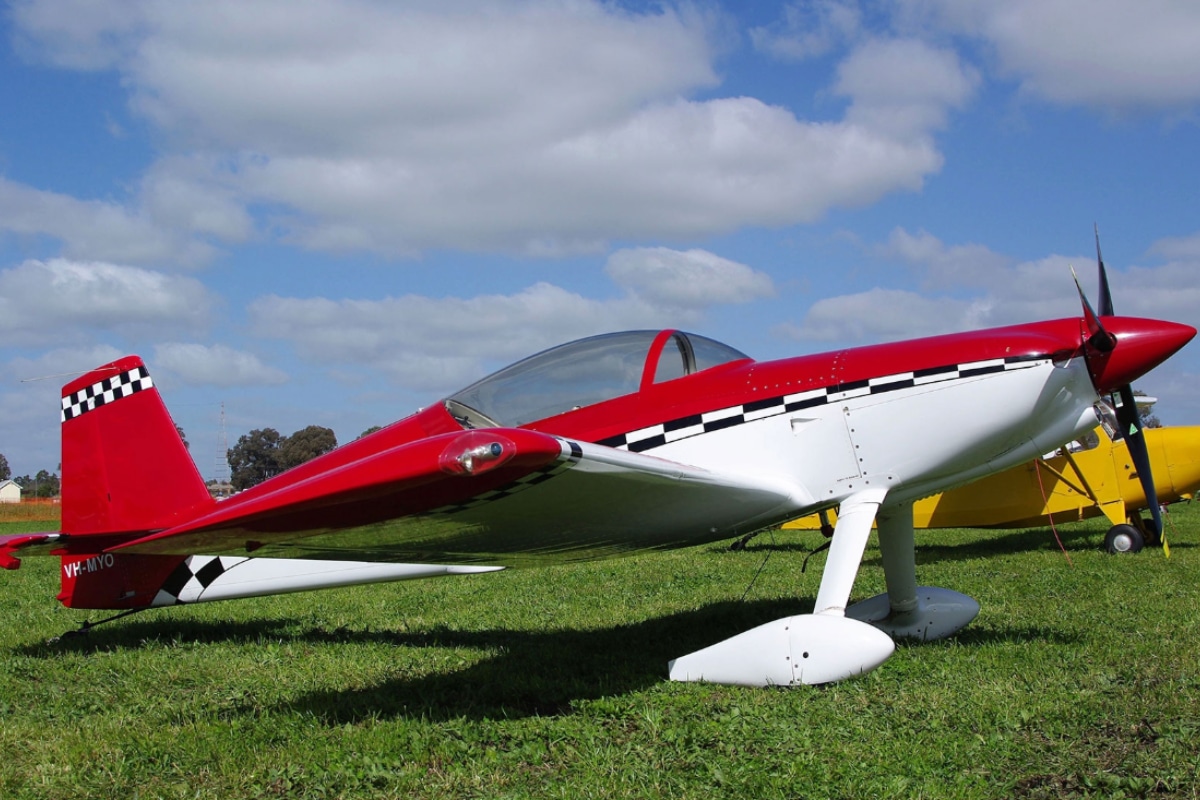
The F1 Rocket is a two-seat sport aircraft built for speed and thrills. Team Rocket designed it in the 1990s, and later Frazier Aviation took over production.
Here’s the cool part: you build it yourself from a kit.
Think of it like a model airplane, except life-sized and you actually fly in it. The plane comes in pieces, and builders put it together in their garage or workshop.
The F1 Rocket sits two people in tandem configuration. That means one person sits behind the other, like on a motorcycle. This design keeps the plane narrow and cuts through the air cleanly.
The Airframe: Built Tough, Built Light
The entire plane is made from aluminum. No wood, no fabric, no composite materials—just metal.
Why does this matter? Aluminum is strong, light, and easy to work with. When you’re building in your garage, you can rivet aluminum sheets together without fancy equipment.
The all-metal construction also means this plane can handle serious aerobatic stress. Rolls, loops, and high-speed dives won’t shake it apart.
F1 Rocket Airplane Specs: The Numbers
Let’s talk dimensions first.
Length: 20.5 feet Wingspan: 21 feet
Wing Area: 79 square feet
The plane is compact. You could park it in a large garage if you removed the wings.
Empty Weight: Around 950 pounds Gross Weight: 1,450 pounds
That’s lighter than most motorcycles with two riders. The low weight is key to the F1 Rocket’s incredible performance.
The Heart of the Beast: Engine Power
Here’s where things get exciting.
The standard F1 Rocket uses a Lycoming IO-540 engine. This six-cylinder powerhouse produces between 250 and 300 horsepower.
To put that in perspective, a typical Cessna 172 trainer has 160 horsepower. The F1 Rocket has nearly twice that power in a lighter airframe.
Some builders choose different engines for their F1 Rockets. The F1 Evo variant can use alternative powerplants, giving builders flexibility based on their budget and performance goals.
F1 Rocket Engine Size and Fuel Needs
The Lycoming IO-540 has a displacement of 540 cubic inches—that’s where the “540” in the name comes from. It’s a big engine designed for aircraft that need serious thrust.
F1 rocket engine fuel consumption varies based on how you fly. At cruise power settings (around 75% throttle), the engine burns roughly 13 to 15 gallons per hour. Push it to full throttle, and consumption jumps significantly.
The fuel tank holds 40 gallons. That gives you about 2.5 to 3 hours of flight time at normal cruise speeds, plus reserves for safety.
Speed: This Thing MOVES
Maximum speed? Try 260 miles per hour.
That’s faster than most cars on the highway. In fact, it’s faster than many World War II fighters.
Cruise speed sits around 240 mph at 75% power. You can dial it back to save fuel, but most F1 Rocket pilots built this plane to go fast.
Compare that to a standard Cessna 172, which cruises at about 120 mph. The F1 Rocket is twice as fast.
Climb Rate: Vertical Performance
The F1 Rocket climbs at approximately 3,500 feet per minute.
Imagine pointing the nose up and climbing 3,500 feet in 60 seconds. That’s like going from sea level to the top of a mountain in one minute.
Most training aircraft climb at 700 to 1,000 feet per minute. The F1 Rocket climbs three to four times faster.
This climb rate comes from the combination of high horsepower and low weight. It’s the same reason sports cars accelerate faster than minivans—power-to-weight ratio matters.
Range and Fuel Capacity
With 40 gallons of fuel and burning 13-15 gallons per hour at cruise, you get a range of about 600 to 700 miles with reserves.
That’s enough to fly from Los Angeles to San Francisco and back, or from New York City to Atlanta.
For a small sport aircraft, that’s solid range. You’re not crossing oceans, but you can definitely take weekend trips.
Takeoff and Landing: Short Field Capable
Takeoff distance: Approximately 600 feet Landing distance: Around 800 feet
The F1 Rocket doesn’t need a massive runway. A small grass strip works fine.
That tailwheel landing gear (the small wheel at the tail instead of the nose) takes some skill to handle. Pilots call these “taildraggers,” and they require more training than tricycle-gear aircraft.
But once you master it, the tailwheel configuration improves ground handling on rough fields and reduces drag in flight.
Stall Speed and G-Force Limits
Stall speed is about 65 mph with flaps down.
That’s the slowest you can fly before the wings stop producing enough lift. It’s relatively high compared to trainer aircraft, which means you need decent runway length and smooth approach speeds.
The F1 Rocket can handle +6G and -3G forces.
That means you can pull six times the force of gravity in upward maneuvers and three times gravity in downward maneuvers. Most people black out around 5-6 Gs, so this plane can handle more stress than your body can.
Aerobatic pilots love these limits. You can do aggressive rolls, loops, and Cuban eights without worrying about overstressing the airframe.
Handling: What Pilots Say
The F1 Rocket is sensitive on the controls. Small stick movements create big responses.
This is exactly what aerobatic pilots want. Responsive controls mean you can place the aircraft precisely where you want it in three-dimensional space.
But for new pilots, it takes adjustment. The plane requires constant attention. It won’t forgive sloppy flying the way a trainer aircraft might.
Experienced pilots describe the handling as “honest.” The plane does what you tell it to do, immediately, without lag or mushiness.
Avionics: Modern Upgrades Available
The F1 Rocket is a kit plane, so avionics packages vary by builder preference.
Many builders install basic VFR instruments: airspeed indicator, altimeter, vertical speed indicator, compass, and engine gauges.
Others go all-in with glass cockpits. Garmin G3X Touch systems, Dynon SkyView displays, and full IFR capability are common upgrades.
Since you’re building the plane yourself, you choose exactly what goes in the panel. Want a simple steam-gauge setup? Done. Want a modern EFIS with synthetic vision? You can have that too.
Building the Kit: Time and Skill Required
The F1 Rocket arrives as a kit with pre-cut parts, hardware, and instructions.
Estimated build time: 1,500 to 2,000 hours
That’s roughly one year if you work 30-40 hours per week. Most builders spread it over two to three years, working evenings and weekends.
Quick-build options exist, where more assembly is done at the factory. This can cut 400-600 hours off your build time.
You don’t need to be an aerospace engineer. Basic mechanical skills, attention to detail, and patience are enough. Thousands of amateur builders have successfully completed F1 Rockets.
F1 Rocket Variants: Standard vs Evo
The standard F1 Rocket is the original design with the straight wing and proven performance numbers I’ve mentioned.
The F1 Evo features a modified wing design for slightly different handling characteristics and can accommodate various engine choices beyond the standard Lycoming.
Both variants deliver exceptional performance. The choice comes down to builder preference and what kind of flying you plan to do.
How Does It Compare to Other Kit Aircraft?
Let’s put the f1 rocket airplane specs next to similar aircraft:
Vans RV-7: Cruises at 180 mph, climbs at 1,200 fpm
Lancair 320: Cruises at 200 mph, climbs at 2,000 fpm
F1 Rocket: Cruises at 240 mph, climbs at 3,500 fpm
The F1 Rocket wins on pure speed and climb rate. It’s one of the fastest kit planes you can build.
The tradeoff? It’s more demanding to fly. The RV-7 is more forgiving and easier for new builders. The Lancair offers a middle ground.
If you want maximum performance and have the skills to handle it, the F1 Rocket delivers.
Who Should Build an F1 Rocket?
This plane is ideal for:
- Experienced pilots who want aerobatic capability
- Speed enthusiasts who crave performance
- Builders comfortable with metal construction
- Pilots who already handle tailwheel aircraft
This plane is NOT ideal for:
- Student pilots learning to fly
- Builders wanting a simple first project
- Pilots who prefer docile, forgiving handling
- Anyone scared of speed
Be honest about your skill level. The F1 Rocket rewards competence and punishes mistakes.
Real-World Performance Stories
Pilots who fly F1 Rockets consistently report the same things:
“It’s the most fun I’ve had in an airplane.”
“The acceleration is insane—like nothing else I’ve flown.”
“You need to stay ahead of it, but that’s part of the thrill.”
One pilot described flying his F1 Rocket cross-country: “I passed a Bonanza like it was standing still. The look on that pilot’s face was priceless.”
These aren’t marketing claims. These are real experiences from real pilots.
The Bottom Line on F1 Rocket Airplane Specs
Let’s recap what makes the F1 Rocket special:
✓ 260 mph maximum speed
✓ 3,500 fpm climb rate
✓ All-metal aluminum construction
✓ Aerobatic capable (+6G/-3G)
✓ 600-700 mile range
✓ Tailwheel configuration
✓ Kit-built aircraft (1,500-2,000 hours)
This airplane delivers fighter-like performance in a homebuilt package.
It’s not the easiest plane to build or fly. But for pilots who want pure speed and aerobatic capability, few kit aircraft come close.
The F1 Rocket proves you don’t need a million-dollar budget to experience high-performance flying. You just need time, skill, and a desire to build something extraordinary. For more information, visit Crew Daily.
Frequently Asked Questions
What is the top speed of the F1 Rocket?
The F1 Rocket reaches a maximum speed of 260 mph, making it one of the fastest kit aircraft available.
How far can it fly on a full tank?
With a 40-gallon fuel tank, the F1 Rocket can fly approximately 600-700 miles at normal cruise settings, depending on winds and power management.
What engine options are available?
The standard engine is a Lycoming IO-540 producing 250-300 horsepower. The F1 Evo variant offers additional engine choices for builders wanting different performance characteristics.
Is the F1 Rocket suitable for beginner pilots?
No. The F1 Rocket’s high performance and sensitive controls require experienced pilots, particularly those comfortable with tailwheel aircraft and high-speed operations.
How long does it take to build an F1 Rocket kit?
Most builders complete the kit in 1,500 to 2,000 hours, typically spread over 2-3 years working part-time. Quick-build options can reduce this by several hundred hours.
Read Also: Su-35 vs Rafale: Speed, Weapons, Radar & Combat Comparison