


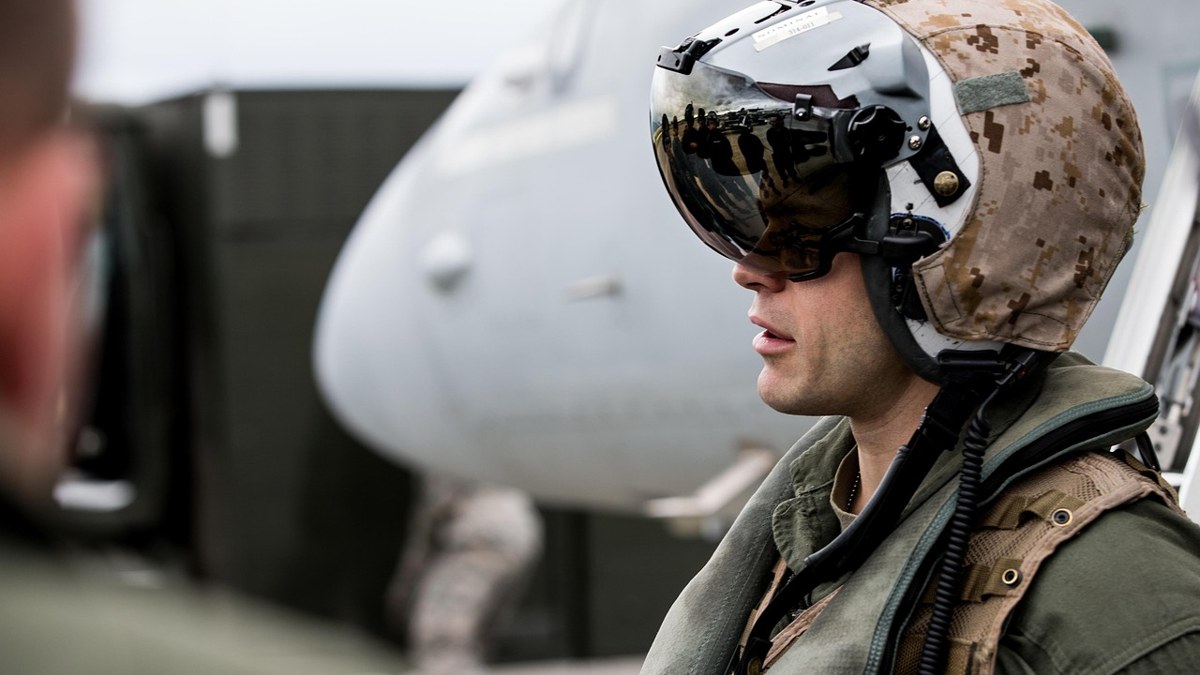
Every year thousands of people decide they want to fly fighters. A few hundred of them, out of every intake, will end up strapped into an F-35, F-16 or Typhoon with live missiles under the wings. The rest are filtered out by a pipeline that is longer, stranger and more brutal than almost any other job interview on earth, and most of the filtering has nothing to do with how well you can fly. Here is how you actually become a fighter pilot, stage by stage, and where people fall off.
Stage 0: you are screened before you touch an aircraft
You cannot simply apply to be a fighter pilot. In every major air force you apply to be an officer first, and only then a pilot candidate, and the first cuts happen on paper. A degree is required in the US, UK and most NATO air forces. There is an age ceiling, typically 32 or 33 at the point of starting flight training. There is a medical that goes far beyond eyesight: colour vision, hearing, sinus and ear function, spinal alignment, heart rhythm, a psychological evaluation, and a set of body measurements, sitting height, leg length, arm reach, that decide whether you can physically fit in, reach the controls of, and safely eject from a specific cockpit. The US Air Force scrapped its old blanket height rule in 2020 precisely because it was excluding otherwise excellent candidates, especially women, who would fit most aircraft fine.
Then come the aptitude tests. The US Air Force’s Test of Basic Aviation Skills and the UK’s Computer Based Aptitude Test are batteries of reaction, multitasking, spatial-reasoning and instrument-reading exercises, and your score is weighed against your flying hours, your degree and your officer evaluations into a single number. That number is what gets you a pilot slot or not. In the US roughly a quarter of those who reach this point get one.
Stage 1: officer training and the first flight
Before any of the flying, there is officer training: the Air Force Academy, ROTC, or Officer Training School in the US; the initial officer course at Cranwell in the UK. Months of drill, leadership evaluation and being shouted at, during which nobody cares that you want to fly. Then, in the US, a short Initial Flight Training course in a light piston aircraft, about 25 hours, whose only purpose is to see whether you can learn to fly at all before the government spends real money on you. People are removed here for airsickness that will not go away, for freezing under instruction, or simply for not learning fast enough.
Stage 2: the year that breaks people
Undergraduate Pilot Training, or its equivalent, is where the reputation comes from. In the US Air Force it is roughly a year, starting in the T-6 Texan II turboprop, and it runs at a pace that has almost nothing in common with civilian flight school. Students are given a flight to prepare for the evening before, are expected to arrive knowing every procedure, checklist item and emergency drill cold, and are graded on every single sortie. A bad grade is a “hook.” Enough hooks in a row and you are put before a review board that can, and does, end your flying career on the spot.
The failure mechanisms are specific and well known to instructors:
- Task saturation. Flying, navigating, talking on the radio and running a checklist at the same time, at 250 knots, while an instructor asks you questions. The people who wash out are usually not bad at any one of those. They are people whose brain locks up when all of them happen at once.
- The stand-up. Every morning a student is picked at random, stands up in front of the class and is given an emergency scenario to talk through step by step, from memory, while the instructors interrupt. Get it wrong and you may be grounded for the day. It is designed to be humiliating, and it is designed to find out who can think while embarrassed and afraid.
- Self-elimination. A surprising number of people simply ask to leave. Officially it is called Drop On Request. Unofficially it is what happens when someone realises, three months in, that they do not actually want the life.
Historically around 15 to 25 percent of a UPT class does not graduate. It sounds survivable until you realise that the ones who reach UPT have already beaten far bigger odds to get there.
Stage 3: the night that decides everything
Roughly halfway through the year comes the moment every student pilot has been thinking about since they applied: track select. Based on cumulative grades, instructor assessments and the needs of the air force that month, each student is assigned to one of a handful of tracks: fighter/bomber (the T-38 Talon in the US), airlift/tanker (the T-1 or now the T-6 advanced track), or helicopters. It is announced at a ceremony, class by class, often with a slide for each student, and it is final.
This is the part outsiders do not understand. Being at the top of your class does not guarantee a fighter. It makes you eligible. If the service needs tanker pilots that quarter, some of the best students in the room will be flying tankers. And “fighter track” only means you go on to the next competition; the type of fighter comes later, in another ceremony, at the end of the T-38 phase, when the class is assigned its actual aircraft and only a handful of F-22 or F-35 slots exist for the whole year. Many superb pilots end up in a cockpit they did not ask for, and most of them come to love it.
Stage 4: learning to fight
Graduating pilot training earns you wings. It does not make you a fighter pilot. That takes another year or more: Introduction to Fighter Fundamentals, where you learn basic air combat and weapons delivery in a trainer, then the Formal Training Unit for your specific type, where you learn the F-16 or F-35 itself, then months of mission qualification at your first squadron before you are allowed to be anything other than a wingman. From the day you started officer training to the day you are a combat-ready fighter pilot is typically three to four years, and you can still be removed at any point along the way.
Stage 5: the boat, if you are Navy
US Navy and Marine Corps pilots go through all of the above with one extra filter that has no equivalent anywhere else: they must land on a ship. Carrier qualification in the T-45 trainer involves catching a wire on a deck moving at 30 knots, at night, in a jet, with a Landing Signal Officer grading every approach against a standard that most pilots describe as the hardest thing they have ever done. Pilots who are otherwise excellent fail here, and there is no fighter career in the Navy without it.
What it costs, and what it commits you to
Training a single fighter pilot costs the US Air Force somewhere between $5 million and $11 million depending on the aircraft, according to the service’s own figures, which is why the pipeline is so ruthless about removing people early and why graduates sign a ten-year service commitment that starts on the day they get their wings. Add the training time and a fighter pilot is committed to the military until their mid-thirties at the earliest. The airlines, which pay far more for far less risk, are waiting at the other end, and the resulting pilot shortage is a permanent headache for every air force in the West.
The people who make it through are not, on the whole, the ones with the fastest reflexes. Instructors say the same thing in every air force: the survivors are the ones who prepare obsessively, stay calm when they are being shouted at, and want it badly enough to keep showing up after a bad day. The flying is the easy part.
For what the job does to the body once you have it, read what 9g actually does to a fighter pilot, and for the civilian version of the same climb, what flight school really costs in 2026.
Frequently asked questions
How long does it take to become a fighter pilot?
Typically three to four years from starting officer training to being combat-ready in a fighter: officer training, initial flight screening, about a year of undergraduate pilot training, then fighter fundamentals and a type conversion course, followed by mission qualification at a squadron.
What percentage of pilot candidates become fighter pilots?
Only a minority. Around a quarter of qualified applicants receive a pilot slot in the US Air Force, 15 to 25 percent of pilot training classes do not graduate, and only a fraction of graduates are assigned to the fighter track, with actual fighter types allocated later based on grades and service needs.
Do you need perfect eyesight to be a fighter pilot?
Not any more. Most air forces now accept corrected vision within limits, and approved laser eye surgery is permitted in the US. Colour vision, depth perception and a broader medical standard still apply.
Can you choose which fighter you fly?
You can state a preference. Assignment is decided by class ranking and what the air force needs at that moment, and only a handful of slots for the newest types exist each year.
